Key takeaways
- The evidence ranges apply to women as written: 1.4–2.0 g/kg/day for active adults [PR01], plateau ~1.62 g/kg/day in the pooled training data [PR02].
- "Toned" = muscle present + body fat managed. There is no toning without the muscle, and protein is how training keeps it.
- "Bulky" requires a years-long project: heavy progressive training plus a sustained calorie surplus. A protein target inside the evidence range builds neither by accident.
- The training effect of protein grows more important with age, not less — in the meta-analysis, added protein's effect on lean mass was reduced with age, which is an argument for aiming at the range deliberately, not drifting under it [PR02].
- Most women I talk to under-eat protein at breakfast and lunch, then try to close the gap at dinner — the distribution fix (about 0.4 g/kg across four meals [PR04]) is the whole game.
- Pregnancy and breastfeeding change the conversation entirely: those seasons belong to you and your clinician, not to an article's ranges.
The same math, worked for a woman's actual day
Take a 60 kg woman who trains three or four times a week. At the plateau the meta-analysis measured, her target is about 97 g of protein a day; the position stand's range puts her between 84 and 120 g [PR01][PR02]. Spread the way the distribution research recommends — roughly 0.4 g/kg at each of four meals [PR04] — that is about 25 g at a time: a Greek-yogurt breakfast, a lunch with a real portion, a shake or snack, a normal dinner. Nothing in that day is extreme, and nothing in it resembles a bodybuilder's cooler of chicken and rice.
Where it usually breaks is not appetite, it is choreography. Breakfast is coffee and toast (4 g). Lunch is a salad built for virtue, not satiety (12 g if the chicken showed up). By dinner she owes the day 80 g, and no single meal carries that gracefully. The fix that works in my house is embarrassingly small: anchor breakfast. My smoothie — the one I make while the kitchen is still mine, before the day starts asking for things — carries a scoop of Goddess Whey Armor or a serving of eggs alongside it, and the day's math stops being a debt.
What "toned" actually is
Every woman who has ever said "I just want to tone up" was describing two things at once: muscle she can see the shape of, and enough softness gone that the shape shows. Both halves are body composition. Neither half is produced by avoiding protein.
Muscle is the metabolically expensive, shape-giving tissue, and it is the tissue midlife takes first when training and protein both run low. Resistance training gives the body the instruction to keep it; protein gives it the material. The pooled data say the material matters measurably — protein supplementation on top of training added lean mass and strength across those 49 studies [PR02] — and they say it for the mixed adult populations the trials enrolled, women included. When a woman tells me she is "doing everything right" but feels softer every year, the first place I look is not her effort. It is whether her protein ever actually reaches the range her training assumes.
Why "bulky" doesn't happen by accident
Let me be direct, because this fear has cost too many women too much muscle: you cannot accidentally become bulky. Visible, stage-level muscularity is the outcome of years of heavy progressive training combined with eating in a deliberate surplus — gaining on purpose, month after month. It is a project people pursue with spreadsheets. Nobody has ever drifted into it via three strength sessions a week and a protein shake.
What the evidence-range protein target does build is the firm, capable version of your own frame: the shoulders that hold a posture, the legs that take stairs two at a time, the arms that carry the groceries in one trip because you decided to. If a woman trains and eats protein and her clothes fit differently, it is almost always because she is more solid, not bigger — muscle is denser than the tissue it gradually replaces. The women I know who lift consistently look like themselves, stronger. That is the entire realistic outcome distribution, and it is a good one.
The case that matters after forty
Here is the part I wish someone had told every woman in my mother's generation. Muscle mass and strength decline with age when nothing opposes them, and the decline accelerates around menopause. In the big meta-analysis, the added benefit of protein supplementation was smaller in older participants [PR02] — researchers read that as older muscle responding less eagerly, which flips the practical advice: the older we get, the less room there is to under-eat protein and get away with it. The position stand's range is a floor to aim at, with training as the multiplier [PR01].
I think of it as independence insurance. The protein I eat at forty-something is not about a photograph; it is about carrying my own suitcase at seventy, getting up off the floor after playing with grandchildren, and keeping the bone-loading habit that lifting gives both muscle and skeleton a reason to stay. Framed that way, a daily shake is not vanity. It is one of the cheapest, pleasantest forms of planning ahead a woman can buy.
The women's shelf, honestly
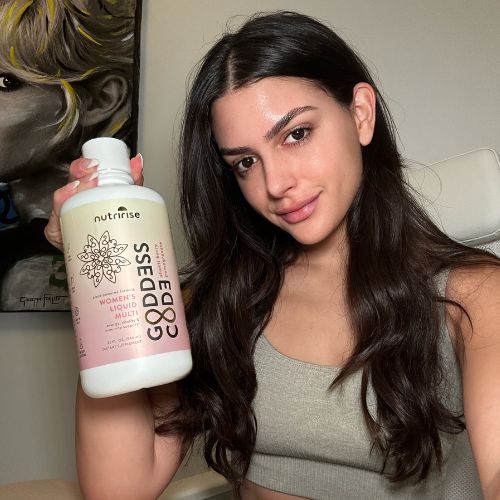
Two of our formulas were built for this reader, and the label article (Reading a Protein Label) verifies every number here. Goddess Whey Armor is, quietly, the best protein value in our whole store: 22 g per serving, 24 servings per tub at $49.90 — $0.095 per gram of protein, the lowest cost per gram on the shelf [PR-L05]. Lean ISO is the minimalist's option: three ingredients — whey isolate, natural flavours, stevia — 18 g per small 25 g scoop, 28 servings [PR-L06]. It costs more per gram ($0.188) and the panel tells you exactly what you are paying for: nothing you did not ask for. Neither will make you bulky. Both will make your breakfast arithmetic considerably easier.
Frequently asked questions
Will whey protein make me bulky?
No — and this is the article in one answer. Bulk is built by years of training volume plus a calorie surplus. Protein inside the evidence range (1.4–2.0 g/kg/day [PR01]) supports the muscle your training maintains; it does not add size your calories and training did not order.
How much protein do I need if I weigh 60 kg and train three times a week?
About 84–120 g a day by the position stand's range, with ~97 g the measured plateau point [PR01][PR02]. Four anchors of ~25 g — the distribution pattern the research supports [PR04] — gets you there without a single enormous meal.
Is plant protein as good for women?
Plant proteins work, with the amino-acid caveat from our comparison article: most are low in one or more essential amino acids, and well-built blends pair complementary sources to close the gap. If you eat plant-based, the daily total matters even more — read Whey Isolate vs Concentrate vs Plant for the full picture.
Does protein matter more during menopause?
The honest version: muscle loss accelerates in those years, and older adults in the trials got less extra benefit from added protein than younger ones [PR02] — which makes deliberately hitting the range, alongside resistance training, more important, not less. For anything beyond that framing — symptoms, hormone questions, bone density — your clinician is the right voice, and this article defers to them.
I'm pregnant or breastfeeding. Should I aim for these ranges?
Those seasons have their own guidance and their own clinician, and general training ranges from an article are not the tool for them. Bring the question to your own care team — protein matters enormously then, which is exactly why it deserves a personal answer rather than a pooled one.
Next step
If you have never actually counted, start with your number: How Much Protein Do You Actually Need? works the math for any body weight. Then let Reading a Protein Label make you un-foolable at the shelf. The whole map lives in Protein, Sorted.
References
[PR01] Jäger R, et al. International Society of Sports Nutrition Position Stand: protein and exercise. Journal of the International Society of Sports Nutrition. 2017;14:20. https://pubmed.ncbi.nlm.nih.gov/28642676/
[PR02] Morton RW, et al. A systematic review, meta-analysis and meta-regression of the effect of protein supplementation on resistance training-induced gains in muscle mass and strength in healthy adults. British Journal of Sports Medicine. 2018;52(6):376–384. https://pubmed.ncbi.nlm.nih.gov/28698222/
[PR04] Schoenfeld BJ, Aragon AA. How much protein can the body use in a single meal for muscle-building? Implications for daily protein distribution. Journal of the International Society of Sports Nutrition. 2018;15:10. https://pubmed.ncbi.nlm.nih.gov/29497353/
• Recommended Products:
.

Whey Armor Isolate — Chocolate Brownie
$49.97
Order Now

Whey Armor Isolate — Vanilla Frosted Donut
$49.97
Order Now

CORE FUEL — Chocolate Brownie
$55.00
Order Now

CORE FUEL — French Vanilla Ice Cream
$55.00
Order Now

Pro Plant Vegan — Cocoa Bomb
$69.95
Order Now

Pro Plant Vegan — Vanilla Cake
$69.95
Order Now













 Cart (


