


Quick answer
Plant-based iron is real iron — it is simply the nonheme kind, which the body absorbs less readily than the heme iron in meat. Two habits close most of the gap: build meals around genuinely iron-rich plant foods (beans, lentils, tofu, spinach, fortified cereals, with amounts below from the NIH), and pair them with vitamin C in the same meal, which enhances nonheme absorption. People eating vegetarian diets are advised to aim for about 1.8 times the standard iron RDA for exactly this reason. Seven workable meals follow — examples to rotate, not a prescription.
Key takeaways
- All plant iron is nonheme; absorption from vegetarian diets runs lower than from mixed diets, which is why the NIH advises vegetarians to target about 1.8× the RDA [W01].
- The heavy lifters, per the NIH's own table: fortified cereal 18 mg per serving, white beans 8 mg per cup, lentils, spinach and firm tofu about 3 mg per half cup, kidney beans and chickpeas about 2 mg per half cup [W01].
- Vitamin C eaten in the same meal enhances nonheme iron absorption — every idea below builds the pairing in rather than bolting it on [W01].
- Phytate, polyphenols (tea and coffee) and calcium at the same meal can work the other way; treat them as scheduling, not bans [W01].
- These are meal ideas, not a treatment plan: a diagnosed deficiency follows a clinician's plan, with food as the foundation under it — the full picture is in our guide to iron deficiency.
The plant-based iron math, briefly
Heme iron arrives in meat, seafood and poultry and absorbs efficiently; nonheme iron — everything plant-based, plus fortified foods — absorbs at a lower rate, roughly 5–12% from vegetarian diets against 14–18% from mixed ones [W01]. That is not a verdict on the diet; it is an instruction to plan it. The NIH's compensating rule is the 1.8× target: a woman whose standard RDA is 18 mg plans around roughly 32 mg of food iron a day. Vitamin C is the other lever: it enhances nonheme absorption, so peppers, tomatoes, citrus and broccoli are not garnish here — they are half the mechanism. Our explainer on heme vs nonheme iron covers the chemistry in full.
The 7 ideas
1. Fortified cereal bowl, done properly. A cereal fortified to 100% of the Daily Value delivers 18 mg of iron in a single serving — the biggest plant-based number on the NIH table [W01]. Add strawberries and a glass of orange juice and the vitamin C pairing is built into breakfast. Check the label: "fortified" spans a wide range, and the 18 mg figure belongs to the fully fortified kind.
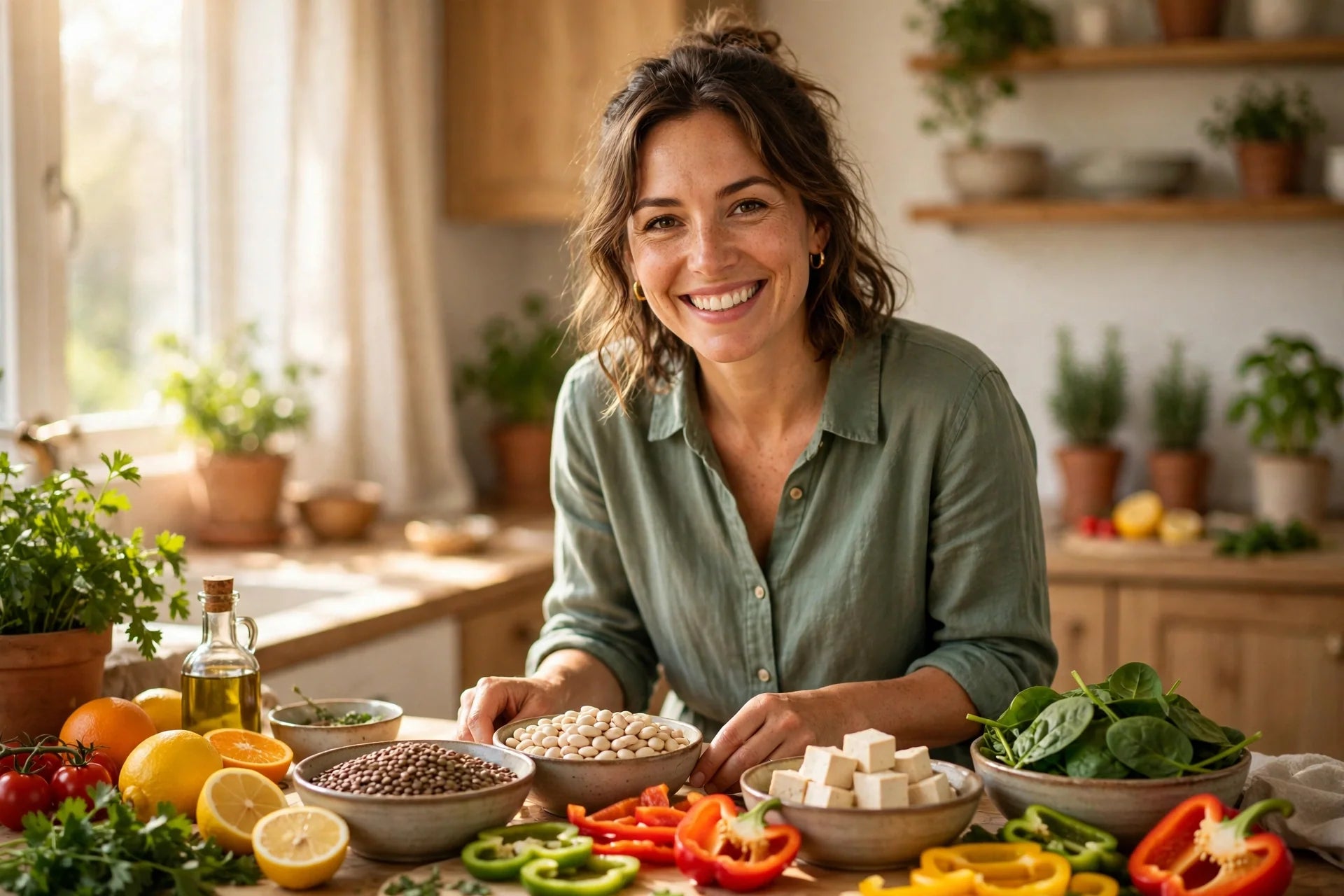
2. White bean and tomato soup. White beans are the quiet champion — 8 mg per cup, more than any other plant food per serving on the list [W01]. Simmered with tomatoes (vitamin C) and garlic, a generous bowl covers a serious share of the day.
3. Lentil curry with bell peppers. Lentils bring about 3 mg per half cup cooked, and a curry easily holds a cup [W01]. Peppers stirred through — or a pepper salad alongside — supply the vitamin C; a squeeze of lime at the table does the same job in the same spirit.
4. Tofu and broccoli stir-fry. Firm tofu contributes about 3 mg per half cup, and broccoli is the pairing partner as well as the co-star [W01]. Ginger, garlic and a citrus-based sauce keep it bright; serve over rice and the meal assembles itself.
5. Spinach and chickpea sauté with lemon. Cooked spinach holds about 3 mg per half cup — cooked is the operative word, since a cup of leaves wilts down to very little — and chickpeas add about 2 mg per half cup [W01]. Lemon juice over the top is the vitamin C, and it is also simply the best version of this dish.
6. Kidney bean chili with tomatoes and peppers. Kidney beans bring about 2 mg per half cup; a chili portion doubles that, in a tomato base that supplies vitamin C while it simmers [W01]. This is the batch-cooking entry on the list — the leftovers are the point.
7. White bean and spinach pasta. The pantry staples combined: white beans (8 mg per cup) folded through pasta with wilted spinach (3 mg per half cup) and a lemon-and-herb dressing [W01]. Fifteen minutes — the best iron meal is the one that actually happens on a tired Tuesday.
A day stitched together
The 1.8× target sounds abstract until you add a day up. Fortified cereal at breakfast (18 mg), white bean soup at lunch (8 mg), and the tofu stir-fry at dinner (about 3 mg in a modest portion, more in a hungry one) lands near 29–32 mg of food iron — the planning zone for a premenopausal woman eating plant-based — before snacks and sides [W01]. Nobody needs to hit a number daily; ordinary meals, chosen with the table in mind, get there without heroics.
What can work against you at the same meal
Three scheduling notes, none of them prohibitions. Tea and coffee carry polyphenols that can reduce nonheme absorption — enjoy them between meals where you can. Calcium at the same meal can reduce absorption too, though the effect attenuates over time. And phytate in grains and legumes is part of why the vitamin C pairing matters [W01]. Our dedicated article on what blocks iron absorption goes deeper — this article's job is the plate, not the pharmacology.
If you are short on iron, not just planning
Meal ideas serve people whose iron is fine and people rebuilding it — differently. If testing has shown a deficiency, food is the foundation but the treatment plan is your clinician's: amounts, form and follow-up testing are set there, and NHLBI's framing of restoration — often three to six months — assumes the plan is actually followed [B01]. Bring this page to that conversation if it helps; do not let it substitute for the conversation.
A brief product note, kept brief on purpose: if your clinician has suggested a daily iron supplement alongside food, formats differ — that comparison lives in our formats article. NutriRise Iron Vitality Strips provide 19 mg of iron as ferric saccharate plus 400 mcg of folate per strip [L01]. Whether any supplement fits your own dietary rules is a label question — read the full ingredient list and decide by it, not by a headline.
Frequently asked questions
Can plant-based eaters really get enough iron?
Yes — with planning rather than luck. The NIH's guidance is explicit that vegetarian diets can meet needs when intake targets account for lower nonheme absorption (the 1.8× rule) and meals use pairings like vitamin C. The ideas above are built to that arithmetic [W01].
Does vitamin C actually make a difference?
It is one of the best-documented levers in this area: vitamin C enhances the absorption of nonheme iron, which is why peppers, tomatoes, citrus and broccoli appear in nearly every idea here rather than as decoration [W01].
Is spinach enough on its own?
Spinach is a genuine contributor — about 3 mg per half cup cooked — but no single food carries a day's target, and spinach's reputation (a cartoon legacy) outruns its numbers. It earns its place as one rotation among beans, lentils, tofu and fortified foods [W01].
If I eat like this, do I still need a supplement?
That depends on your iron status, which is a blood test, not a menu assessment. Plenty of plant-based eaters need nothing beyond food; some, especially with heavy periods or a diagnosed deficiency, need more. Test, then decide — our guide to iron deficiency explains the testing side.
Can these meals treat iron-deficiency anemia?
No. They are iron-rich eating patterns that support intake — valuable, and for many people sufficient for maintenance — but treating a diagnosed deficiency is a clinician-directed plan with follow-up testing, not a recipe collection [B01].
Next step
Pick two of the seven and put them on this week's rotation — the cereal bowl and one bean-based dinner is the easiest start. Then, at your next shop, restock by the NIH table: beans, lentils, tofu, spinach, fortified cereal, and the peppers, tomatoes and citrus that make them count.
References
[W01] NIH Office of Dietary Supplements — Iron, Fact Sheet for Health Professionals: food amounts (fortified cereal 18 mg/serving; white beans 8 mg/cup; lentils, boiled spinach, firm tofu ~3 mg per ½ cup; kidney beans and chickpeas ~2 mg per ½ cup); nonheme absorption 5–12% vegetarian vs 14–18% mixed diets; vegetarians advised ~1.8× RDA; vitamin C and muscle protein enhance nonheme absorption; phytate and polyphenols inhibit; calcium effect at a meal attenuated over time. https://ods.od.nih.gov/factsheets/Iron-HealthProfessional/
[B01] National Heart, Lung, and Blood Institute (NHLBI) — Iron-Deficiency Anemia: restoring iron levels often takes three to six months with treatment; treatment follows a clinician's plan. https://www.nhlbi.nih.gov/health/anemia/iron-deficiency-anemia
[L01] NutriRise — Iron Vitality Strips product page: 19 mg iron as ferric saccharate, 400 mcg folate per strip. https://nutririse.com/products/nutririse-iron-vitality-strips-fast-dissolving-iron-folate-for-daily-energy
• Recommended Products:





 Cart (


