Travel Hydration: Flights, Road Trips and Hot Destinations

Quick answer

Travel stacks small fluid losses on top of each other: cabin air on a plane is kept very dry, so you lose water through breath and skin for hours; airport routines replace drinking with queuing and coffee; and the destination is often hotter than home. None of it is dangerous for a healthy traveller who plans — all of it is miserable for one who doesn't. The system that works is the same one from our everyday guide, travel-fitted: start the trip hydrated, carry a bottle you actually refill, put one electrolyte drink into long travel days (Warrior Code Vital Hydrate, 100 mg sodium and 200 mg potassium per scoop [L01], or Harmony Hydration [L08]), eat real meals on arrival, and give hot destinations two or three days of respect before you train or hike like a local.

Key takeaways

  • Flights dehydrate by environment, not by altitude magic: very dry cabin air plus hours of sitting, sleeping and under-drinking.
  • A practical in-flight rhythm: a glass of water roughly every couple of hours on long hauls, more if you feel dry — a heuristic that beats both neglect and forced litre-chugging.
  • Alcohol at altitude is a double withdrawal from the same account; our alcohol article does that ledger in full.
  • Road trips fail on access, not knowledge: the bottle belongs in the cup holder, and fuel stops are drink stops.
  • Hot destinations tax newcomers hardest in the first days; heat guidance from occupational health — water, rest, shade, gradual build-up [H01] — applies to tourists exactly as to workers.
  • Hydration does not cure jet lag. Light timing and sleep do that work; arriving hydrated simply removes one amplifier of feeling terrible.

The flight: a dry room that moves

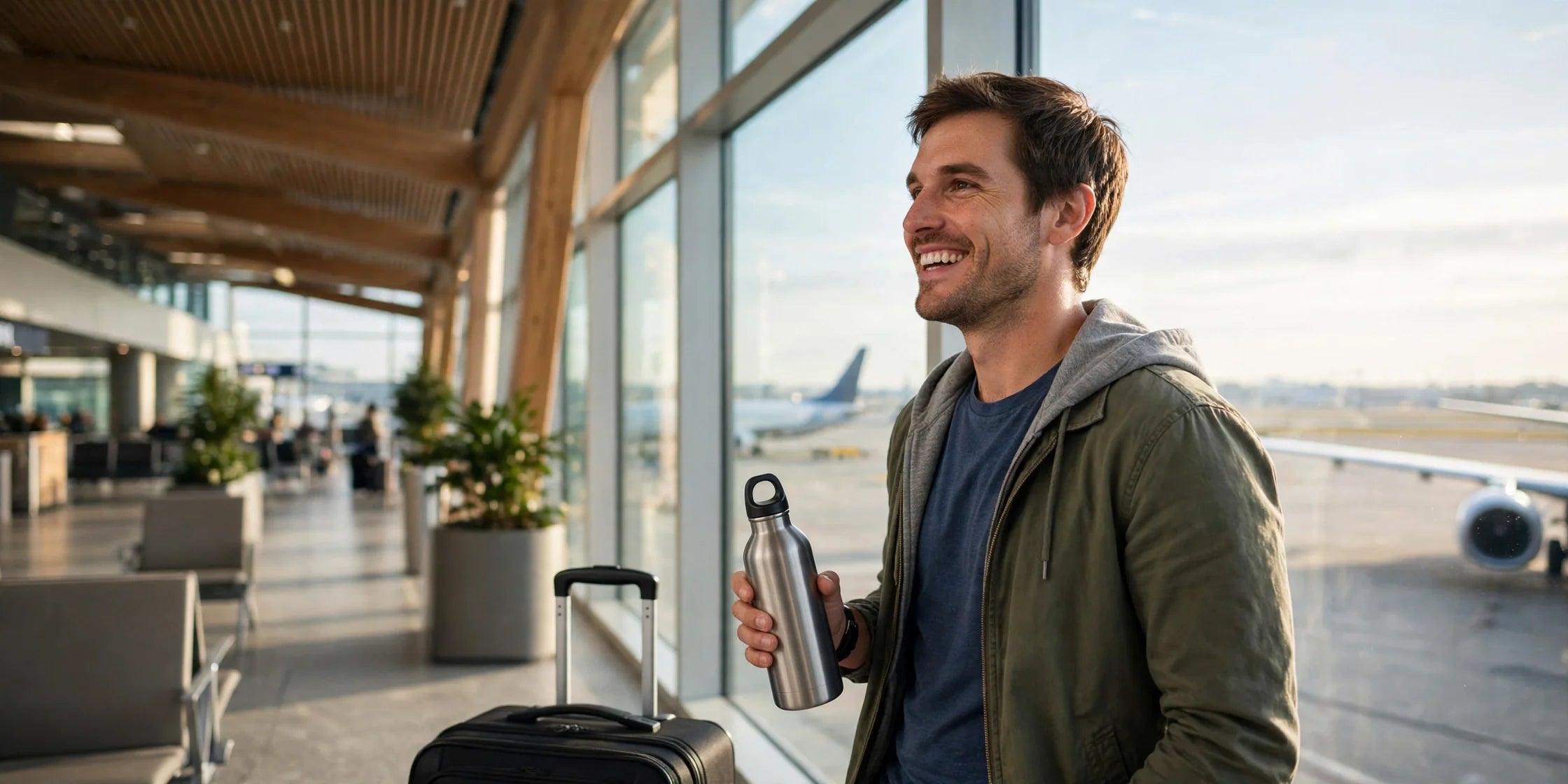
Aircraft cabins are pressurised and their air is drawn from outside at altitude, where it holds almost no moisture; the result is an environment drier than most deserts, for the full length of the flight. You will not feel yourself sweating — losses through breath and skin are invisible — but a long-haul day can quietly cost what a sweaty hour costs at home, while your intake usually falls: small cups, sleeping through services, not wanting the aisle walk. Counter it structurally. Start the day hydrated (the morning routine applies at 4 a.m. too). Fill a bottle after security and keep it in the seat pocket, not the overhead bin. On flights over four hours, make one of those bottles an electrolyte drink — the light daily chassis exists for exactly these long, low-grade losses [L01][L08]. Eat the meal; food is fluid and salt together. And treat airport and in-flight alcohol as what it is: a withdrawal, covered honestly in this series' alcohol article.

The road trip: access is the whole game

Nobody dehydrates on a road trip from ignorance; they dehydrate because the water is in the boot, the next stop is an hour away, and the driver is rationing drinks against bathroom stops. Solve it like logistics: a full bottle per person in the cabin, refilled at every fuel and food stop; those stops scheduled rather than heroic; and a hard rule for hot climates — a parked car becomes an oven, so drinks and people never wait inside one. Arrive-and-recover is the same as the flight version: a real meal, drinks with it, and an evening check on how the day went before an early night.

Hot destinations: respect the first three days

Heat acclimatisation is physiology, not toughness: full adaptation takes one to two weeks, and the first days in a hot place are when visitors get into trouble — sightseeing at noon, training at home intensity, drinking like they're still in a temperate office. Occupational heat guidance scales down cleanly to travellers [H01]: water close at hand, rest breaks in shade as the heat demands, exertion built up gradually day by day. If training is the point of the trip, the athlete library takes over — sweat rates, sodium by the litre, the works. For everyone else, the visitor's version suffices: front-load the morning, siesta the peak, and let urine colour referee.

The travel playbook, on one timeline

The night before: normal dinner, normal drinks, packed bottle empty in the hand luggage, electrolyte sachets in the wash bag. Travel morning: the standard morning routine, however early the alarm morning guide. In transit: bottle filled after security (or at the first fuel stop), steady sipping on the glass-per-couple-of-hours rhythm, one electrolyte drink on any leg over four hours, alcohol counted as a withdrawal and mostly declined. On arrival: a real meal with drinks before anything heroic; urine check; early night. The first morning: morning routine, daylight, and the day's exertion kept one notch below home until the body votes otherwise — which, in heat, means two or three days of voting.

A word for competition trips, since I make them: travelling to compete adds a weigh-in and a bracket to the usual stack, and the temptation is to manage fluids like a strategy. Don't. Arrive hydrated and stay that way — the athlete library's stance on rapid weight manipulation is a hard no, for health reasons that outrank any bracket athlete guide — and the competitor who slept, ate and drank normally is the one still sharp in the final.

Jet lag: the honest paragraph

Fluid is not the jet lag lever. Circadian misalignment is, and its tools are light exposure, sleep timing and patience. What dehydration does is amplify — a dry traveller's headache, fatigue and fog stack on top of the time-zone symptoms and make day one feel like day none. Arrive hydrated so the only problem you have is the clock. Travellers with medical conditions, and anyone on diuretics or fluid-sensitive medication, should treat long-haul planning as a clinician question — the older adults article covers the medication side of that conversation.

Frequently asked questions

How much should I drink on a long flight?

Start hydrated, keep a filled bottle in the seat pocket, and drink steadily — roughly a glass every couple of hours on long hauls is a workable rhythm, more if the cabin feels drying or you wake with a dry mouth. One electrolyte drink on a long sector is a sensible anchor [L01][L08].

Does flying dehydrate you because of altitude itself?

Mostly it is the dry cabin air plus behaviour — hours without drinking properly. The fix is environmental and structural (bottle access, steady sipping), not medical.

Can I take electrolyte powder on a plane?

Powders travel in hand luggage without issue in most places; mix after security with your filled bottle. As with anything security-related, local rules win — but a sealed tub or sachets of drink powder is unremarkable travel kit.

Is it worth hydrating extra the day before travel?

Arriving at the airport normally hydrated is the goal; deliberate over-drinking the day before mostly schedules bathroom trips. Eat normally, drink to thirst, sleep — the boring trilogy wins again.

I'm travelling somewhere hot and want to train — where do I start?

With humility for three days, then with the athlete hydration guide: measure your sweat rate, size sodium to it, and build intensity as the days pass [A01][H01].

Next step

Travel days are won by the same routine as ordinary days, packed better. If alcohol is part of the trip — it usually is — read Alcohol and Hydration before the first airport beer.

References

[D01] Institute of Medicine — Dietary Reference Intakes for Water, Potassium, Sodium, Chloride, and Sulfate (National Academies Press, 2005): total water reference intakes for adults: https://nap.nationalacademies.org/read/10925

[A01] American College of Sports Medicine — Position Stand: Exercise and Fluid Replacement (2007; PMID 17277604): begin exercise/travel days euhydrated; replace according to losses; sodium-containing drinks benefit prolonged exertion: https://pubmed.ncbi.nlm.nih.gov/17277604/

[H01] OSHA — Heat Illness Prevention Campaign ("Water. Rest. Shade."): cool water close at hand, rest breaks scaled to heat, shade or cool areas, and gradual acclimatisation over days for anyone unaccustomed to heat: https://www.osha.gov/heat-exposure

[L01] Warrior Code Vital Hydrate — Supplement Facts label (verified 2026-10-28): per 1 scoop (5.4 g): sodium 100 mg, potassium 200 mg, magnesium 20 mg, calcium 40 mg, B-complex 33% DV; caffeine-free: https://nutririse.com/products/warrior-code-vital-hydrate-lychee

[L08] AdaptoZen Harmony Hydration — Supplement Facts label (verified 2026-11-05): per 1 scoop: sodium 100 mg, potassium 200 mg, magnesium 20 mg, calcium 40 mg; caffeine-free: https://nutririse.com/products/adaptozen-harmony-hydration-golden-passion-caffeine-free-electrolytes-b-vitamins-for-all-day-wellness

• Recommended Products:

.

AdaptoZen Harmony Hydration

AdaptoZen Harmony Hydration

$39.95

Order Now
Goddess Code Green Tara Matcha Hydration

Goddess Code Green Tara Matcha Hydration

$39.95

Order Now
Goddess Code Athena

Goddess Code Athena

$39.95

Order Now
Warrior Code Vital Hydrate

Warrior Code Vital Hydrate

$39.95

Order Now
Mineral Matrix+

Mineral Matrix+

$49.95

Order Now
Goddess Code AURA+

Goddess Code AURA+

$39.95

Order Now
AdaptoZen Ignite Energy

AdaptoZen Ignite Energy

$39.95

Order Now
Travel Hydration: Flights, Road Trips and Hot Destinations

Travel Hydration: Flights, Road Trips and Hot Destinations

Quick answer

Travel stacks small fluid losses on top of each other: cabin air on a plane is kept very dry, so you lose water through breath and skin for hours; airport routines replace drinking with queuing and coffee; and the destination is often hotter than home. None of it is dangerous for a healthy traveller who plans — all of it is miserable for one who doesn't. The system that works is the same one from our everyday guide, travel-fitted: start the trip hydrated, carry a bottle you actually refill, put one electrolyte drink into long travel days (Warrior Code Vital Hydrate, 100 mg sodium and 200 mg potassium per scoop [L01], or Harmony Hydration [L08]), eat real meals on arrival, and give hot destinations two or three days of respect before you train or hike like a local.

Key takeaways

  • Flights dehydrate by environment, not by altitude magic: very dry cabin air plus hours of sitting, sleeping and under-drinking.
  • A practical in-flight rhythm: a glass of water roughly every couple of hours on long hauls, more if you feel dry — a heuristic that beats both neglect and forced litre-chugging.
  • Alcohol at altitude is a double withdrawal from the same account; our alcohol article does that ledger in full.
  • Road trips fail on access, not knowledge: the bottle belongs in the cup holder, and fuel stops are drink stops.
  • Hot destinations tax newcomers hardest in the first days; heat guidance from occupational health — water, rest, shade, gradual build-up [H01] — applies to tourists exactly as to workers.
  • Hydration does not cure jet lag. Light timing and sleep do that work; arriving hydrated simply removes one amplifier of feeling terrible.

The flight: a dry room that moves

Aircraft cabins are pressurised and their air is drawn from outside at altitude, where it holds almost no moisture; the result is an environment drier than most deserts, for the full length of the flight. You will not feel yourself sweating — losses through breath and skin are invisible — but a long-haul day can quietly cost what a sweaty hour costs at home, while your intake usually falls: small cups, sleeping through services, not wanting the aisle walk. Counter it structurally. Start the day hydrated (the morning routine applies at 4 a.m. too). Fill a bottle after security and keep it in the seat pocket, not the overhead bin. On flights over four hours, make one of those bottles an electrolyte drink — the light daily chassis exists for exactly these long, low-grade losses [L01][L08]. Eat the meal; food is fluid and salt together. And treat airport and in-flight alcohol as what it is: a withdrawal, covered honestly in this series' alcohol article.

The road trip: access is the whole game

Nobody dehydrates on a road trip from ignorance; they dehydrate because the water is in the boot, the next stop is an hour away, and the driver is rationing drinks against bathroom stops. Solve it like logistics: a full bottle per person in the cabin, refilled at every fuel and food stop; those stops scheduled rather than heroic; and a hard rule for hot climates — a parked car becomes an oven, so drinks and people never wait inside one. Arrive-and-recover is the same as the flight version: a real meal, drinks with it, and an evening check on how the day went before an early night.

Hot destinations: respect the first three days

Heat acclimatisation is physiology, not toughness: full adaptation takes one to two weeks, and the first days in a hot place are when visitors get into trouble — sightseeing at noon, training at home intensity, drinking like they're still in a temperate office. Occupational heat guidance scales down cleanly to travellers [H01]: water close at hand, rest breaks in shade as the heat demands, exertion built up gradually day by day. If training is the point of the trip, the athlete library takes over — sweat rates, sodium by the litre, the works. For everyone else, the visitor's version suffices: front-load the morning, siesta the peak, and let urine colour referee.

The travel playbook, on one timeline

The night before: normal dinner, normal drinks, packed bottle empty in the hand luggage, electrolyte sachets in the wash bag. Travel morning: the standard morning routine, however early the alarm morning guide. In transit: bottle filled after security (or at the first fuel stop), steady sipping on the glass-per-couple-of-hours rhythm, one electrolyte drink on any leg over four hours, alcohol counted as a withdrawal and mostly declined. On arrival: a real meal with drinks before anything heroic; urine check; early night. The first morning: morning routine, daylight, and the day's exertion kept one notch below home until the body votes otherwise — which, in heat, means two or three days of voting.

A word for competition trips, since I make them: travelling to compete adds a weigh-in and a bracket to the usual stack, and the temptation is to manage fluids like a strategy. Don't. Arrive hydrated and stay that way — the athlete library's stance on rapid weight manipulation is a hard no, for health reasons that outrank any bracket athlete guide — and the competitor who slept, ate and drank normally is the one still sharp in the final.

Jet lag: the honest paragraph

Fluid is not the jet lag lever. Circadian misalignment is, and its tools are light exposure, sleep timing and patience. What dehydration does is amplify — a dry traveller's headache, fatigue and fog stack on top of the time-zone symptoms and make day one feel like day none. Arrive hydrated so the only problem you have is the clock. Travellers with medical conditions, and anyone on diuretics or fluid-sensitive medication, should treat long-haul planning as a clinician question — the older adults article covers the medication side of that conversation.

Frequently asked questions

How much should I drink on a long flight?

Start hydrated, keep a filled bottle in the seat pocket, and drink steadily — roughly a glass every couple of hours on long hauls is a workable rhythm, more if the cabin feels drying or you wake with a dry mouth. One electrolyte drink on a long sector is a sensible anchor [L01][L08].

Does flying dehydrate you because of altitude itself?

Mostly it is the dry cabin air plus behaviour — hours without drinking properly. The fix is environmental and structural (bottle access, steady sipping), not medical.

Can I take electrolyte powder on a plane?

Powders travel in hand luggage without issue in most places; mix after security with your filled bottle. As with anything security-related, local rules win — but a sealed tub or sachets of drink powder is unremarkable travel kit.

Is it worth hydrating extra the day before travel?

Arriving at the airport normally hydrated is the goal; deliberate over-drinking the day before mostly schedules bathroom trips. Eat normally, drink to thirst, sleep — the boring trilogy wins again.

I'm travelling somewhere hot and want to train — where do I start?

With humility for three days, then with the athlete hydration guide: measure your sweat rate, size sodium to it, and build intensity as the days pass [A01][H01].

Next step

Travel days are won by the same routine as ordinary days, packed better. If alcohol is part of the trip — it usually is — read Alcohol and Hydration before the first airport beer.

References

[D01] Institute of Medicine — Dietary Reference Intakes for Water, Potassium, Sodium, Chloride, and Sulfate (National Academies Press, 2005): total water reference intakes for adults: https://nap.nationalacademies.org/read/10925

[A01] American College of Sports Medicine — Position Stand: Exercise and Fluid Replacement (2007; PMID 17277604): begin exercise/travel days euhydrated; replace according to losses; sodium-containing drinks benefit prolonged exertion: https://pubmed.ncbi.nlm.nih.gov/17277604/

[H01] OSHA — Heat Illness Prevention Campaign ("Water. Rest. Shade."): cool water close at hand, rest breaks scaled to heat, shade or cool areas, and gradual acclimatisation over days for anyone unaccustomed to heat: https://www.osha.gov/heat-exposure

[L01] Warrior Code Vital Hydrate — Supplement Facts label (verified 2026-10-28): per 1 scoop (5.4 g): sodium 100 mg, potassium 200 mg, magnesium 20 mg, calcium 40 mg, B-complex 33% DV; caffeine-free: https://nutririse.com/products/warrior-code-vital-hydrate-lychee

[L08] AdaptoZen Harmony Hydration — Supplement Facts label (verified 2026-11-05): per 1 scoop: sodium 100 mg, potassium 200 mg, magnesium 20 mg, calcium 40 mg; caffeine-free: https://nutririse.com/products/adaptozen-harmony-hydration-golden-passion-caffeine-free-electrolytes-b-vitamins-for-all-day-wellness

• Recommended Products:

.

AdaptoZen Harmony Hydration

AdaptoZen Harmony Hydration

$39.95

Order Now
Goddess Code Green Tara Matcha Hydration

Goddess Code Green Tara Matcha Hydration

$39.95

Order Now
Goddess Code Athena

Goddess Code Athena

$39.95

Order Now
Warrior Code Vital Hydrate

Warrior Code Vital Hydrate

$39.95

Order Now
Mineral Matrix+

Mineral Matrix+

$49.95

Order Now
Goddess Code AURA+

Goddess Code AURA+

$39.95

Order Now
AdaptoZen Ignite Energy

AdaptoZen Ignite Energy

$39.95

Order Now
Basim Mirza
Basim Mirza
Co-founder, NutriRise · BJJ Gold Medalist
Co-founder of NutriRise and BJJ gold medalist. Basim writes about t...
Learn More
Travel Hydration: Flights, Road Trips and Hot Destinations

Quick answer

Travel stacks small fluid losses on top of each other: cabin air on a plane is kept very dry, so you lose water through breath and skin for hours; airport routines replace drinking with queuing and coffee; and the destination is often hotter than home. None of it is dangerous for a healthy traveller who plans — all of it is miserable for one who doesn't. The system that works is the same one from our everyday guide, travel-fitted: start the trip hydrated, carry a bottle you actually refill, put one electrolyte drink into long travel days (Warrior Code Vital Hydrate, 100 mg sodium and 200 mg potassium per scoop [L01], or Harmony Hydration [L08]), eat real meals on arrival, and give hot destinations two or three days of respect before you train or hike like a local.

Key takeaways

  • Flights dehydrate by environment, not by altitude magic: very dry cabin air plus hours of sitting, sleeping and under-drinking.
  • A practical in-flight rhythm: a glass of water roughly every couple of hours on long hauls, more if you feel dry — a heuristic that beats both neglect and forced litre-chugging.
  • Alcohol at altitude is a double withdrawal from the same account; our alcohol article does that ledger in full.
  • Road trips fail on access, not knowledge: the bottle belongs in the cup holder, and fuel stops are drink stops.
  • Hot destinations tax newcomers hardest in the first days; heat guidance from occupational health — water, rest, shade, gradual build-up [H01] — applies to tourists exactly as to workers.
  • Hydration does not cure jet lag. Light timing and sleep do that work; arriving hydrated simply removes one amplifier of feeling terrible.

The flight: a dry room that moves

Aircraft cabins are pressurised and their air is drawn from outside at altitude, where it holds almost no moisture; the result is an environment drier than most deserts, for the full length of the flight. You will not feel yourself sweating — losses through breath and skin are invisible — but a long-haul day can quietly cost what a sweaty hour costs at home, while your intake usually falls: small cups, sleeping through services, not wanting the aisle walk. Counter it structurally. Start the day hydrated (the morning routine applies at 4 a.m. too). Fill a bottle after security and keep it in the seat pocket, not the overhead bin. On flights over four hours, make one of those bottles an electrolyte drink — the light daily chassis exists for exactly these long, low-grade losses [L01][L08]. Eat the meal; food is fluid and salt together. And treat airport and in-flight alcohol as what it is: a withdrawal, covered honestly in this series' alcohol article.

The road trip: access is the whole game

Nobody dehydrates on a road trip from ignorance; they dehydrate because the water is in the boot, the next stop is an hour away, and the driver is rationing drinks against bathroom stops. Solve it like logistics: a full bottle per person in the cabin, refilled at every fuel and food stop; those stops scheduled rather than heroic; and a hard rule for hot climates — a parked car becomes an oven, so drinks and people never wait inside one. Arrive-and-recover is the same as the flight version: a real meal, drinks with it, and an evening check on how the day went before an early night.

Hot destinations: respect the first three days

Heat acclimatisation is physiology, not toughness: full adaptation takes one to two weeks, and the first days in a hot place are when visitors get into trouble — sightseeing at noon, training at home intensity, drinking like they're still in a temperate office. Occupational heat guidance scales down cleanly to travellers [H01]: water close at hand, rest breaks in shade as the heat demands, exertion built up gradually day by day. If training is the point of the trip, the athlete library takes over — sweat rates, sodium by the litre, the works. For everyone else, the visitor's version suffices: front-load the morning, siesta the peak, and let urine colour referee.

The travel playbook, on one timeline

The night before: normal dinner, normal drinks, packed bottle empty in the hand luggage, electrolyte sachets in the wash bag. Travel morning: the standard morning routine, however early the alarm morning guide. In transit: bottle filled after security (or at the first fuel stop), steady sipping on the glass-per-couple-of-hours rhythm, one electrolyte drink on any leg over four hours, alcohol counted as a withdrawal and mostly declined. On arrival: a real meal with drinks before anything heroic; urine check; early night. The first morning: morning routine, daylight, and the day's exertion kept one notch below home until the body votes otherwise — which, in heat, means two or three days of voting.

A word for competition trips, since I make them: travelling to compete adds a weigh-in and a bracket to the usual stack, and the temptation is to manage fluids like a strategy. Don't. Arrive hydrated and stay that way — the athlete library's stance on rapid weight manipulation is a hard no, for health reasons that outrank any bracket athlete guide — and the competitor who slept, ate and drank normally is the one still sharp in the final.

Jet lag: the honest paragraph

Fluid is not the jet lag lever. Circadian misalignment is, and its tools are light exposure, sleep timing and patience. What dehydration does is amplify — a dry traveller's headache, fatigue and fog stack on top of the time-zone symptoms and make day one feel like day none. Arrive hydrated so the only problem you have is the clock. Travellers with medical conditions, and anyone on diuretics or fluid-sensitive medication, should treat long-haul planning as a clinician question — the older adults article covers the medication side of that conversation.

Frequently asked questions

How much should I drink on a long flight?

Start hydrated, keep a filled bottle in the seat pocket, and drink steadily — roughly a glass every couple of hours on long hauls is a workable rhythm, more if the cabin feels drying or you wake with a dry mouth. One electrolyte drink on a long sector is a sensible anchor [L01][L08].

Does flying dehydrate you because of altitude itself?

Mostly it is the dry cabin air plus behaviour — hours without drinking properly. The fix is environmental and structural (bottle access, steady sipping), not medical.

Can I take electrolyte powder on a plane?

Powders travel in hand luggage without issue in most places; mix after security with your filled bottle. As with anything security-related, local rules win — but a sealed tub or sachets of drink powder is unremarkable travel kit.

Is it worth hydrating extra the day before travel?

Arriving at the airport normally hydrated is the goal; deliberate over-drinking the day before mostly schedules bathroom trips. Eat normally, drink to thirst, sleep — the boring trilogy wins again.

I'm travelling somewhere hot and want to train — where do I start?

With humility for three days, then with the athlete hydration guide: measure your sweat rate, size sodium to it, and build intensity as the days pass [A01][H01].

Next step

Travel days are won by the same routine as ordinary days, packed better. If alcohol is part of the trip — it usually is — read Alcohol and Hydration before the first airport beer.

References

[D01] Institute of Medicine — Dietary Reference Intakes for Water, Potassium, Sodium, Chloride, and Sulfate (National Academies Press, 2005): total water reference intakes for adults: https://nap.nationalacademies.org/read/10925

[A01] American College of Sports Medicine — Position Stand: Exercise and Fluid Replacement (2007; PMID 17277604): begin exercise/travel days euhydrated; replace according to losses; sodium-containing drinks benefit prolonged exertion: https://pubmed.ncbi.nlm.nih.gov/17277604/

[H01] OSHA — Heat Illness Prevention Campaign ("Water. Rest. Shade."): cool water close at hand, rest breaks scaled to heat, shade or cool areas, and gradual acclimatisation over days for anyone unaccustomed to heat: https://www.osha.gov/heat-exposure

[L01] Warrior Code Vital Hydrate — Supplement Facts label (verified 2026-10-28): per 1 scoop (5.4 g): sodium 100 mg, potassium 200 mg, magnesium 20 mg, calcium 40 mg, B-complex 33% DV; caffeine-free: https://nutririse.com/products/warrior-code-vital-hydrate-lychee

[L08] AdaptoZen Harmony Hydration — Supplement Facts label (verified 2026-11-05): per 1 scoop: sodium 100 mg, potassium 200 mg, magnesium 20 mg, calcium 40 mg; caffeine-free: https://nutririse.com/products/adaptozen-harmony-hydration-golden-passion-caffeine-free-electrolytes-b-vitamins-for-all-day-wellness

• Recommended Products:

.

AdaptoZen Harmony Hydration

AdaptoZen Harmony Hydration

$39.95

Order Now
Goddess Code Green Tara Matcha Hydration

Goddess Code Green Tara Matcha Hydration

$39.95

Order Now
Goddess Code Athena

Goddess Code Athena

$39.95

Order Now
Warrior Code Vital Hydrate

Warrior Code Vital Hydrate

$39.95

Order Now
Mineral Matrix+

Mineral Matrix+

$49.95

Order Now
Goddess Code AURA+

Goddess Code AURA+

$39.95

Order Now
AdaptoZen Ignite Energy

AdaptoZen Ignite Energy

$39.95

Order Now
Cart (0)
Your Cart Is Empty!
Start With Our Best Sellers
NutriRise Ashwagandha Root 1300 MG | Organic Black Pepper Extract | 120 Capsules
$21.95
NutriRise 15-Day Rapid Cleanse | 9 Natural Ingredients with Aloe Vera & Senna | Plus Probiotics
$15.45
NutriRise Glucosamine Chondroitin MSM | 8 Ingredient Joint Support Blend | 90 Capsules
$29.95
Thanks for contacting us! We'll get back to you shortly. Thanks for subscribing Thanks! We will notify you when it becomes available! Product is out of stock. There is only one item left to add to the cart There are only [num_items] items left to add to the cart