Hyponatremia: When Athletes Drink Too Much Water

Quick answer

Hyponatremia is blood sodium diluted too low — in athletes, usually because they drank far more fluid than they lost, during or after exercise. The 2015 International Exercise-Associated Hyponatremia Consensus, summarised in the 2017 update, identifies overconsumption of fluids beyond thirst, combined with the body's exercise-related fluid retention (non-osmotic AVP release), as the primary mechanism [E01]. It can happen in any sport — cases are documented from marathons to football, team sports and even yoga classes [E01] — and its warning pattern is paradoxical: the athlete who finishes heavier than they started, with a headache, nausea, confusion or worse [E01]. The prevention is simple: drink to thirst, plan from your measured sweat rate, and never force fluids on a schedule.

Key takeaways

  • Exercise-associated hyponatremia (EAH) means blood sodium below the normal range during or up to 24 hours after activity; by laboratory definition, below 135 mmol/L [E01].
  • The main cause is drinking beyond thirst — water or sports drinks — faster than the body loses and can excrete it, compounded by AVP-driven fluid retention during exercise [E01].
  • Weight gain during exercise is the tell-tale sign of the fluid excess behind most cases [E01].
  • Symptoms escalate from headache, nausea and bloating to confusion, seizures and collapse. Confusion after heavy drinking is an emergency — and more water is the worst response.
  • Prevention is behavioural: drink to thirst, know your sweat rate, and retire "drink as much as possible" from your club's vocabulary [E01].
  • This article leads with the danger, not a product. That is deliberate: the honest version of this subject protects athletes, and it is the version a hydration brand should publish.

The danger in the other direction

Hydration advice exists because dehydration is real — the rest of this library, starting with the complete athlete guide, is built on replacing what sweat takes. But the pendulum in sports culture swung hard: "drink before you're thirsty," "drink as much as you can tolerate," "keep your urine clear." The hyponatremia consensus statement exists because that advice, taken seriously by conscientious athletes, has killed people — including, the consensus panel noted, two high-school football players whose deaths prompted the 2015 update [E01].

This article is the counterweight. It is part of a hydration cluster on a supplement company's blog, and it says, without hedging: our products are not protection against this condition, more fluid is not always safer, and the most dangerous hydration advice an athlete can follow is to override their own thirst by force of will.

What hyponatremia actually is

Blood sodium concentration is a balance: sodium on one side, water on the other. It falls when water accumulates out of proportion to sodium — in exercise, overwhelmingly because intake of water or other low-sodium drinks exceeds sweat, urine and other losses, while the hormone AVP (arginine vasopressin) simultaneously tells the kidneys to hold onto water rather than excrete it [E01]. Cells then absorb the excess water and swell; most tissues tolerate this, but the brain, inside a rigid skull, does not — which is why the severe form, hyponatremic encephalopathy, is a neurological emergency [E01].

Sweat sodium loss plays, at most, a supporting role. Losing salty sweat alone tends to concentrate blood sodium; it contributes mainly when the losses are replaced with large volumes of low-sodium fluid, or when volume depletion itself triggers more AVP release [E01]. The practical translation: you cannot sweat your way into this condition and then fix it by drinking harder. The driver is the drinking.

Who it happens to

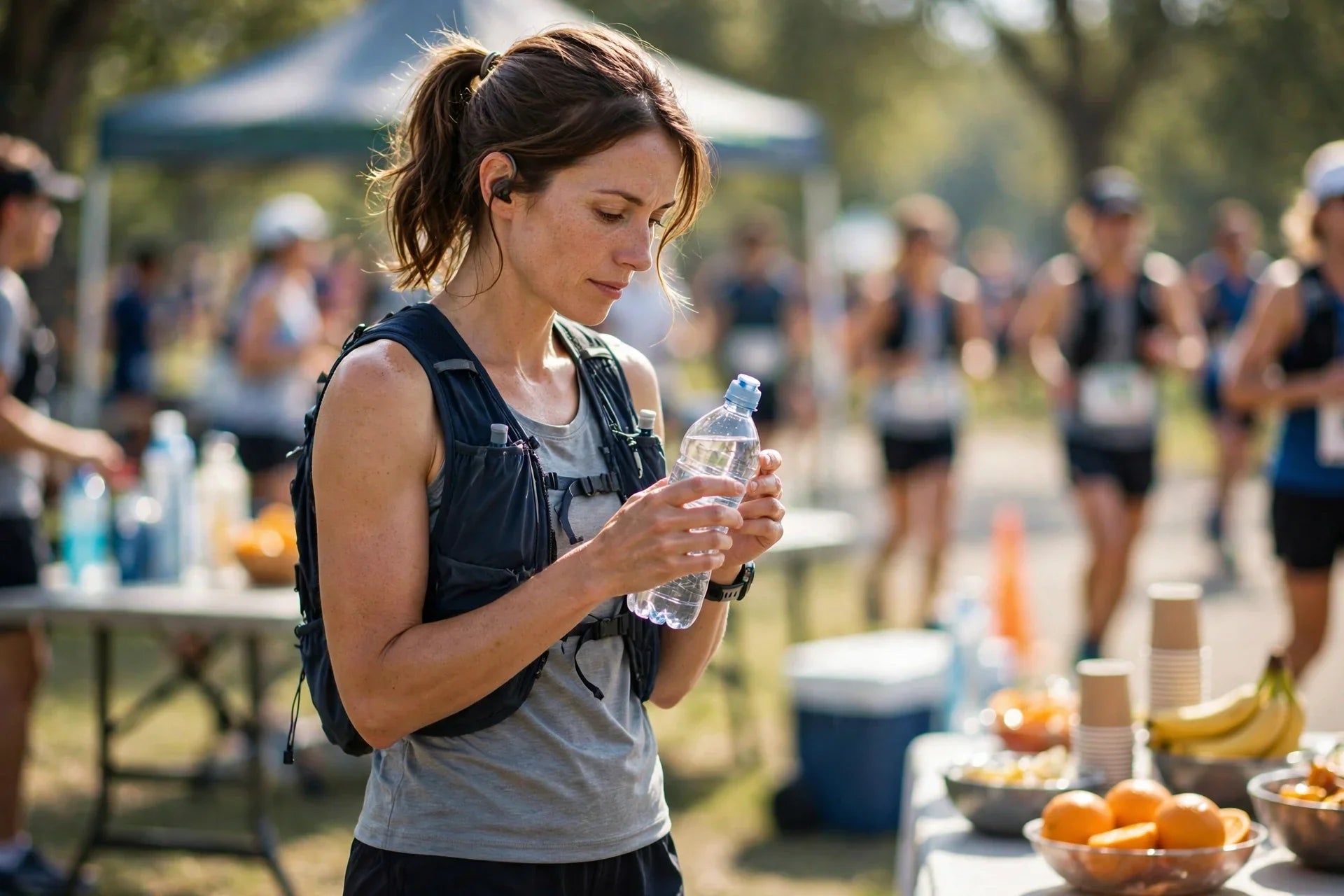
EAH was first described in ultramarathon runners in the 1980s, but the documented map is now much wider: marathon and Ironman fields, team sports, American football practices, military training, hiking, cycling, swimming — and, in the case literature, yoga classes and two hours of weightlifting plus tennis [E01]. Slower participants in long events are overrepresented for an unglamorous reason: they are on the course longest, with the most aid stations, losing less sweat per hour than the leaders while drinking on the same advice.

For this library's readers, the relevant scenarios are not exotic: the grappler who force-drinks between every round of a long open mat "to stay ahead of hydration"; the endurance athlete executing a rigid litre-per-hour rule regardless of conditions; the hot-yoga practitioner who arrives having pre-loaded litres of water on an instructor's advice. Any setting where drinking is treated as a discipline rather than a response to thirst can produce it. The full endurance application — planning by sweat rate, aid stations, and drinking to thirst inside a planned range — is in Endurance Hydration: Running, Cycling and the Long Session.

The signs — and the one that shows on the scale

Early EAH is easy to mistake for ordinary exhaustion or for dehydration itself: headache, nausea, bloating or a sloshing stomach, puffiness (tight rings, swollen hands), unusual fatigue [E01]. That overlap is treacherous, because the standard response — "you look dehydrated, drink more" — is exactly wrong here. As it progresses: vomiting, confusion, disorientation, agitation, slurred speech; in severe cases, seizures, coma and death from brain swelling [E01].

Against that ambiguity, one sign is objective and worth engraving: weight. An athlete who has gained weight during exercise has, by definition, taken in more fluid than they lost, and the majority of symptomatic EAH cases show exactly that gain [E01]. It is why the signs of dehydration guide in this library lists "finished heavier than I started" as a red flag rather than a success. A bathroom scale at the finish line is a screening tool; use it.

What to do if you suspect it

If an athlete is confused, disoriented, seizing, or collapsing after heavy fluid intake: call emergency services immediately. Do not give them more water or sports drink. Tell the responders how much the person drank and that you suspect hyponatremia; treatment is medical and is guided by symptoms, with concentrated (hypertonic) saline used in hospital care for serious cases [E01]. Mild, fully alert cases still warrant medical assessment rather than a self-prescribed salt binge — the line between mild and serious is a clinician's call, not a teammate's.

Prevention: thirst, a scale, and honest coaching

The consensus prevention strategy is almost disappointingly simple [E01]:

  • Drink to thirst. The 2015 statement concluded that using the innate thirst mechanism to guide fluid consumption limits drinking in excess while providing sufficient fluid to prevent excessive dehydration [E01]. Thirst is not a broken dashboard light; it is the control system.
  • Know your number. A measured sweat rate caps the plan from above: there is no scenario in which drinking more than you sweat, hour after hour, is a performance strategy.
  • Respect the 2% window the other way. The ACSM's during-exercise target is a band, not a floor: finish within about 2% of starting weight on the loss side [A01] — and at or near your starting weight on the gain side, never meaningfully above it.
  • Fix the culture. Coaches, instructors and training partners: retire "push fluids," "drink until your urine is clear," and forced water breaks with quotas. Excessive fluid intake does not prevent cramps, fatigue or heat stroke — the conditions it is usually prescribed for [E01].
  • Sodium is a supporting actor. Salty food and electrolyte drinks around long sessions are reasonable and appear throughout this library's plans — but they do not license unlimited drinking. Sports drinks are still mostly water and can dilute blood sodium when consumed in excess [E01].

Why a supplement brand publishes this

Because trust is the business. Warrior Code sells electrolyte formulas for people who lose litres of sweat, and those athletes deserve the whole map: sweat costs sodium (replace it), the replacement has an upper edge (respect it), and the most credentialed hydration advice in the world — the ACSM position stand [A01] and the international hyponatremia consensus [E01] — agrees on both halves. If this article is the only one in the library you ever read, it has done its job.

Frequently asked questions

What is exercise-associated hyponatremia?

A drop in blood sodium concentration (below 135 mmol/L) that develops during or up to 24 hours after physical activity [E01]. In athletes it is primarily dilutional: too much low-sodium fluid taken in beyond thirst, retained under the influence of exercise-related AVP release [E01].

Can sports drinks cause hyponatremia too?

Yes. Sports and electrolyte drinks are hypotonic relative to blood — mostly water with modest sodium — so drinking them far beyond losses can dilute blood sodium the same way water does [E01]. The sodium in them reduces the risk per litre; it does not remove it.

How is hyponatremia different from dehydration?

They are opposite fluid states with overlapping early symptoms (headache, nausea, fatigue). Dehydration is a water deficit — weight down, thirst up. Hyponatremia is usually a water excess relative to sodium — often weight up. The scale separates them better than symptoms do [E01][A01].

Who is most at risk?

Participants in long events who drink on a fixed schedule beyond thirst, especially slower athletes with hours of aid-station access; athletes in sports with a forced-drinking culture; and anyone whose plan is built on "as much as possible" [E01]. Cases span endurance sport, team sport, football, military training, hiking and yoga [E01].

If I feel awful during a long event, should I drink more?

Not automatically. Check the direction of your weight if you can, and think about which problem you have: lost more than ~2% of body weight with strong thirst points to deficit [A01]; weight stable or up, bloating, puffiness and a headache after heavy drinking points to excess [E01]. Confusion, in either case, is an emergency-services call, not a drinking decision.

Does eating salt prevent hyponatremia?

Salt with food and fluids helps replace sweat losses and is part of sensible long-session planning, but the consensus is clear that the primary prevention is behavioural — not drinking beyond thirst [E01]. Salt does not make unlimited intake safe.

Next step

Audit your own hydration habits against one question: is my drinking driven by thirst and a measured plan, or by a rule someone shouted at a seminar? Then read the library's two companion gauges — signs of dehydration in athletes for the deficit side and Hydration & Electrolytes for Athletes for the full system — and keep both edges of the road in view.

References

[E01] Hew-Butler T et al. — Exercise-Associated Hyponatremia: 2017 Update (Frontiers in Medicine), summarising the 2015 Third International EAH Consensus Development Conference: EAH is blood sodium below 135 mmol/L during or up to 24 hours after activity; primary mechanisms are overconsumption of hypotonic fluids beyond thirst and non-osmotic AVP secretion; weight gain during exercise marks fluid excess; cases documented across endurance, team, football, military, hiking and yoga settings; drinking to thirst is the core prevention; severe cases are treated medically with hypertonic saline: https://pmc.ncbi.nlm.nih.gov/articles/PMC5334560/

[A01] American College of Sports Medicine — Position Stand: Exercise and Fluid Replacement (2007): the during-exercise goal is to prevent >2% body-weight loss from water deficit and excessive electrolyte imbalance; individualised programmes based on measured sweat rate: https://pubmed.ncbi.nlm.nih.gov/17277604/

• Recommended Products:

.

Warrior Code Vital Hydrate

Warrior Code Vital Hydrate

$39.95

Order Now
Warrior Code HYDRA ICE

Warrior Code HYDRA ICE

$42.00

Order Now
NutriRise ION — Quantum Ice

NutriRise ION — Quantum Ice

$49.95

Order Now
Mineral Matrix+

Mineral Matrix+

$49.95

Order Now
Warrior Code Power Pulse

Warrior Code Power Pulse

$39.95

Order Now
AdaptoZen Harmony Hydration

AdaptoZen Harmony Hydration

$39.95

Order Now
Warrior Code Volcanic Salt

Warrior Code Volcanic Salt

$49.99

Order Now
Hyponatremia: When Athletes Drink Too Much Water

Hyponatremia: When Athletes Drink Too Much Water

Quick answer

Hyponatremia is blood sodium diluted too low — in athletes, usually because they drank far more fluid than they lost, during or after exercise. The 2015 International Exercise-Associated Hyponatremia Consensus, summarised in the 2017 update, identifies overconsumption of fluids beyond thirst, combined with the body's exercise-related fluid retention (non-osmotic AVP release), as the primary mechanism [E01]. It can happen in any sport — cases are documented from marathons to football, team sports and even yoga classes [E01] — and its warning pattern is paradoxical: the athlete who finishes heavier than they started, with a headache, nausea, confusion or worse [E01]. The prevention is simple: drink to thirst, plan from your measured sweat rate, and never force fluids on a schedule.

Key takeaways

  • Exercise-associated hyponatremia (EAH) means blood sodium below the normal range during or up to 24 hours after activity; by laboratory definition, below 135 mmol/L [E01].
  • The main cause is drinking beyond thirst — water or sports drinks — faster than the body loses and can excrete it, compounded by AVP-driven fluid retention during exercise [E01].
  • Weight gain during exercise is the tell-tale sign of the fluid excess behind most cases [E01].
  • Symptoms escalate from headache, nausea and bloating to confusion, seizures and collapse. Confusion after heavy drinking is an emergency — and more water is the worst response.
  • Prevention is behavioural: drink to thirst, know your sweat rate, and retire "drink as much as possible" from your club's vocabulary [E01].
  • This article leads with the danger, not a product. That is deliberate: the honest version of this subject protects athletes, and it is the version a hydration brand should publish.

The danger in the other direction

Hydration advice exists because dehydration is real — the rest of this library, starting with the complete athlete guide, is built on replacing what sweat takes. But the pendulum in sports culture swung hard: "drink before you're thirsty," "drink as much as you can tolerate," "keep your urine clear." The hyponatremia consensus statement exists because that advice, taken seriously by conscientious athletes, has killed people — including, the consensus panel noted, two high-school football players whose deaths prompted the 2015 update [E01].

This article is the counterweight. It is part of a hydration cluster on a supplement company's blog, and it says, without hedging: our products are not protection against this condition, more fluid is not always safer, and the most dangerous hydration advice an athlete can follow is to override their own thirst by force of will.

What hyponatremia actually is

Blood sodium concentration is a balance: sodium on one side, water on the other. It falls when water accumulates out of proportion to sodium — in exercise, overwhelmingly because intake of water or other low-sodium drinks exceeds sweat, urine and other losses, while the hormone AVP (arginine vasopressin) simultaneously tells the kidneys to hold onto water rather than excrete it [E01]. Cells then absorb the excess water and swell; most tissues tolerate this, but the brain, inside a rigid skull, does not — which is why the severe form, hyponatremic encephalopathy, is a neurological emergency [E01].

Sweat sodium loss plays, at most, a supporting role. Losing salty sweat alone tends to concentrate blood sodium; it contributes mainly when the losses are replaced with large volumes of low-sodium fluid, or when volume depletion itself triggers more AVP release [E01]. The practical translation: you cannot sweat your way into this condition and then fix it by drinking harder. The driver is the drinking.

Who it happens to

EAH was first described in ultramarathon runners in the 1980s, but the documented map is now much wider: marathon and Ironman fields, team sports, American football practices, military training, hiking, cycling, swimming — and, in the case literature, yoga classes and two hours of weightlifting plus tennis [E01]. Slower participants in long events are overrepresented for an unglamorous reason: they are on the course longest, with the most aid stations, losing less sweat per hour than the leaders while drinking on the same advice.

For this library's readers, the relevant scenarios are not exotic: the grappler who force-drinks between every round of a long open mat "to stay ahead of hydration"; the endurance athlete executing a rigid litre-per-hour rule regardless of conditions; the hot-yoga practitioner who arrives having pre-loaded litres of water on an instructor's advice. Any setting where drinking is treated as a discipline rather than a response to thirst can produce it. The full endurance application — planning by sweat rate, aid stations, and drinking to thirst inside a planned range — is in Endurance Hydration: Running, Cycling and the Long Session.

The signs — and the one that shows on the scale

Early EAH is easy to mistake for ordinary exhaustion or for dehydration itself: headache, nausea, bloating or a sloshing stomach, puffiness (tight rings, swollen hands), unusual fatigue [E01]. That overlap is treacherous, because the standard response — "you look dehydrated, drink more" — is exactly wrong here. As it progresses: vomiting, confusion, disorientation, agitation, slurred speech; in severe cases, seizures, coma and death from brain swelling [E01].

Against that ambiguity, one sign is objective and worth engraving: weight. An athlete who has gained weight during exercise has, by definition, taken in more fluid than they lost, and the majority of symptomatic EAH cases show exactly that gain [E01]. It is why the signs of dehydration guide in this library lists "finished heavier than I started" as a red flag rather than a success. A bathroom scale at the finish line is a screening tool; use it.

What to do if you suspect it

If an athlete is confused, disoriented, seizing, or collapsing after heavy fluid intake: call emergency services immediately. Do not give them more water or sports drink. Tell the responders how much the person drank and that you suspect hyponatremia; treatment is medical and is guided by symptoms, with concentrated (hypertonic) saline used in hospital care for serious cases [E01]. Mild, fully alert cases still warrant medical assessment rather than a self-prescribed salt binge — the line between mild and serious is a clinician's call, not a teammate's.

Prevention: thirst, a scale, and honest coaching

The consensus prevention strategy is almost disappointingly simple [E01]:

  • Drink to thirst. The 2015 statement concluded that using the innate thirst mechanism to guide fluid consumption limits drinking in excess while providing sufficient fluid to prevent excessive dehydration [E01]. Thirst is not a broken dashboard light; it is the control system.
  • Know your number. A measured sweat rate caps the plan from above: there is no scenario in which drinking more than you sweat, hour after hour, is a performance strategy.
  • Respect the 2% window the other way. The ACSM's during-exercise target is a band, not a floor: finish within about 2% of starting weight on the loss side [A01] — and at or near your starting weight on the gain side, never meaningfully above it.
  • Fix the culture. Coaches, instructors and training partners: retire "push fluids," "drink until your urine is clear," and forced water breaks with quotas. Excessive fluid intake does not prevent cramps, fatigue or heat stroke — the conditions it is usually prescribed for [E01].
  • Sodium is a supporting actor. Salty food and electrolyte drinks around long sessions are reasonable and appear throughout this library's plans — but they do not license unlimited drinking. Sports drinks are still mostly water and can dilute blood sodium when consumed in excess [E01].

Why a supplement brand publishes this

Because trust is the business. Warrior Code sells electrolyte formulas for people who lose litres of sweat, and those athletes deserve the whole map: sweat costs sodium (replace it), the replacement has an upper edge (respect it), and the most credentialed hydration advice in the world — the ACSM position stand [A01] and the international hyponatremia consensus [E01] — agrees on both halves. If this article is the only one in the library you ever read, it has done its job.

Frequently asked questions

What is exercise-associated hyponatremia?

A drop in blood sodium concentration (below 135 mmol/L) that develops during or up to 24 hours after physical activity [E01]. In athletes it is primarily dilutional: too much low-sodium fluid taken in beyond thirst, retained under the influence of exercise-related AVP release [E01].

Can sports drinks cause hyponatremia too?

Yes. Sports and electrolyte drinks are hypotonic relative to blood — mostly water with modest sodium — so drinking them far beyond losses can dilute blood sodium the same way water does [E01]. The sodium in them reduces the risk per litre; it does not remove it.

How is hyponatremia different from dehydration?

They are opposite fluid states with overlapping early symptoms (headache, nausea, fatigue). Dehydration is a water deficit — weight down, thirst up. Hyponatremia is usually a water excess relative to sodium — often weight up. The scale separates them better than symptoms do [E01][A01].

Who is most at risk?

Participants in long events who drink on a fixed schedule beyond thirst, especially slower athletes with hours of aid-station access; athletes in sports with a forced-drinking culture; and anyone whose plan is built on "as much as possible" [E01]. Cases span endurance sport, team sport, football, military training, hiking and yoga [E01].

If I feel awful during a long event, should I drink more?

Not automatically. Check the direction of your weight if you can, and think about which problem you have: lost more than ~2% of body weight with strong thirst points to deficit [A01]; weight stable or up, bloating, puffiness and a headache after heavy drinking points to excess [E01]. Confusion, in either case, is an emergency-services call, not a drinking decision.

Does eating salt prevent hyponatremia?

Salt with food and fluids helps replace sweat losses and is part of sensible long-session planning, but the consensus is clear that the primary prevention is behavioural — not drinking beyond thirst [E01]. Salt does not make unlimited intake safe.

Next step

Audit your own hydration habits against one question: is my drinking driven by thirst and a measured plan, or by a rule someone shouted at a seminar? Then read the library's two companion gauges — signs of dehydration in athletes for the deficit side and Hydration & Electrolytes for Athletes for the full system — and keep both edges of the road in view.

References

[E01] Hew-Butler T et al. — Exercise-Associated Hyponatremia: 2017 Update (Frontiers in Medicine), summarising the 2015 Third International EAH Consensus Development Conference: EAH is blood sodium below 135 mmol/L during or up to 24 hours after activity; primary mechanisms are overconsumption of hypotonic fluids beyond thirst and non-osmotic AVP secretion; weight gain during exercise marks fluid excess; cases documented across endurance, team, football, military, hiking and yoga settings; drinking to thirst is the core prevention; severe cases are treated medically with hypertonic saline: https://pmc.ncbi.nlm.nih.gov/articles/PMC5334560/

[A01] American College of Sports Medicine — Position Stand: Exercise and Fluid Replacement (2007): the during-exercise goal is to prevent >2% body-weight loss from water deficit and excessive electrolyte imbalance; individualised programmes based on measured sweat rate: https://pubmed.ncbi.nlm.nih.gov/17277604/

• Recommended Products:

.

Warrior Code Vital Hydrate

Warrior Code Vital Hydrate

$39.95

Order Now
Warrior Code HYDRA ICE

Warrior Code HYDRA ICE

$42.00

Order Now
NutriRise ION — Quantum Ice

NutriRise ION — Quantum Ice

$49.95

Order Now
Mineral Matrix+

Mineral Matrix+

$49.95

Order Now
Warrior Code Power Pulse

Warrior Code Power Pulse

$39.95

Order Now
AdaptoZen Harmony Hydration

AdaptoZen Harmony Hydration

$39.95

Order Now
Warrior Code Volcanic Salt

Warrior Code Volcanic Salt

$49.99

Order Now
Ramsha Mirza
Ramsha Mirza
Co-Founder of NutriRise
Co-founder of NutriRise and mother of three. Ramsha writes about th...
Learn More
Hyponatremia: When Athletes Drink Too Much Water

Quick answer

Hyponatremia is blood sodium diluted too low — in athletes, usually because they drank far more fluid than they lost, during or after exercise. The 2015 International Exercise-Associated Hyponatremia Consensus, summarised in the 2017 update, identifies overconsumption of fluids beyond thirst, combined with the body's exercise-related fluid retention (non-osmotic AVP release), as the primary mechanism [E01]. It can happen in any sport — cases are documented from marathons to football, team sports and even yoga classes [E01] — and its warning pattern is paradoxical: the athlete who finishes heavier than they started, with a headache, nausea, confusion or worse [E01]. The prevention is simple: drink to thirst, plan from your measured sweat rate, and never force fluids on a schedule.

Key takeaways

  • Exercise-associated hyponatremia (EAH) means blood sodium below the normal range during or up to 24 hours after activity; by laboratory definition, below 135 mmol/L [E01].
  • The main cause is drinking beyond thirst — water or sports drinks — faster than the body loses and can excrete it, compounded by AVP-driven fluid retention during exercise [E01].
  • Weight gain during exercise is the tell-tale sign of the fluid excess behind most cases [E01].
  • Symptoms escalate from headache, nausea and bloating to confusion, seizures and collapse. Confusion after heavy drinking is an emergency — and more water is the worst response.
  • Prevention is behavioural: drink to thirst, know your sweat rate, and retire "drink as much as possible" from your club's vocabulary [E01].
  • This article leads with the danger, not a product. That is deliberate: the honest version of this subject protects athletes, and it is the version a hydration brand should publish.

The danger in the other direction

Hydration advice exists because dehydration is real — the rest of this library, starting with the complete athlete guide, is built on replacing what sweat takes. But the pendulum in sports culture swung hard: "drink before you're thirsty," "drink as much as you can tolerate," "keep your urine clear." The hyponatremia consensus statement exists because that advice, taken seriously by conscientious athletes, has killed people — including, the consensus panel noted, two high-school football players whose deaths prompted the 2015 update [E01].

This article is the counterweight. It is part of a hydration cluster on a supplement company's blog, and it says, without hedging: our products are not protection against this condition, more fluid is not always safer, and the most dangerous hydration advice an athlete can follow is to override their own thirst by force of will.

What hyponatremia actually is

Blood sodium concentration is a balance: sodium on one side, water on the other. It falls when water accumulates out of proportion to sodium — in exercise, overwhelmingly because intake of water or other low-sodium drinks exceeds sweat, urine and other losses, while the hormone AVP (arginine vasopressin) simultaneously tells the kidneys to hold onto water rather than excrete it [E01]. Cells then absorb the excess water and swell; most tissues tolerate this, but the brain, inside a rigid skull, does not — which is why the severe form, hyponatremic encephalopathy, is a neurological emergency [E01].

Sweat sodium loss plays, at most, a supporting role. Losing salty sweat alone tends to concentrate blood sodium; it contributes mainly when the losses are replaced with large volumes of low-sodium fluid, or when volume depletion itself triggers more AVP release [E01]. The practical translation: you cannot sweat your way into this condition and then fix it by drinking harder. The driver is the drinking.

Who it happens to

EAH was first described in ultramarathon runners in the 1980s, but the documented map is now much wider: marathon and Ironman fields, team sports, American football practices, military training, hiking, cycling, swimming — and, in the case literature, yoga classes and two hours of weightlifting plus tennis [E01]. Slower participants in long events are overrepresented for an unglamorous reason: they are on the course longest, with the most aid stations, losing less sweat per hour than the leaders while drinking on the same advice.

For this library's readers, the relevant scenarios are not exotic: the grappler who force-drinks between every round of a long open mat "to stay ahead of hydration"; the endurance athlete executing a rigid litre-per-hour rule regardless of conditions; the hot-yoga practitioner who arrives having pre-loaded litres of water on an instructor's advice. Any setting where drinking is treated as a discipline rather than a response to thirst can produce it. The full endurance application — planning by sweat rate, aid stations, and drinking to thirst inside a planned range — is in Endurance Hydration: Running, Cycling and the Long Session.

The signs — and the one that shows on the scale

Early EAH is easy to mistake for ordinary exhaustion or for dehydration itself: headache, nausea, bloating or a sloshing stomach, puffiness (tight rings, swollen hands), unusual fatigue [E01]. That overlap is treacherous, because the standard response — "you look dehydrated, drink more" — is exactly wrong here. As it progresses: vomiting, confusion, disorientation, agitation, slurred speech; in severe cases, seizures, coma and death from brain swelling [E01].

Against that ambiguity, one sign is objective and worth engraving: weight. An athlete who has gained weight during exercise has, by definition, taken in more fluid than they lost, and the majority of symptomatic EAH cases show exactly that gain [E01]. It is why the signs of dehydration guide in this library lists "finished heavier than I started" as a red flag rather than a success. A bathroom scale at the finish line is a screening tool; use it.

What to do if you suspect it

If an athlete is confused, disoriented, seizing, or collapsing after heavy fluid intake: call emergency services immediately. Do not give them more water or sports drink. Tell the responders how much the person drank and that you suspect hyponatremia; treatment is medical and is guided by symptoms, with concentrated (hypertonic) saline used in hospital care for serious cases [E01]. Mild, fully alert cases still warrant medical assessment rather than a self-prescribed salt binge — the line between mild and serious is a clinician's call, not a teammate's.

Prevention: thirst, a scale, and honest coaching

The consensus prevention strategy is almost disappointingly simple [E01]:

  • Drink to thirst. The 2015 statement concluded that using the innate thirst mechanism to guide fluid consumption limits drinking in excess while providing sufficient fluid to prevent excessive dehydration [E01]. Thirst is not a broken dashboard light; it is the control system.
  • Know your number. A measured sweat rate caps the plan from above: there is no scenario in which drinking more than you sweat, hour after hour, is a performance strategy.
  • Respect the 2% window the other way. The ACSM's during-exercise target is a band, not a floor: finish within about 2% of starting weight on the loss side [A01] — and at or near your starting weight on the gain side, never meaningfully above it.
  • Fix the culture. Coaches, instructors and training partners: retire "push fluids," "drink until your urine is clear," and forced water breaks with quotas. Excessive fluid intake does not prevent cramps, fatigue or heat stroke — the conditions it is usually prescribed for [E01].
  • Sodium is a supporting actor. Salty food and electrolyte drinks around long sessions are reasonable and appear throughout this library's plans — but they do not license unlimited drinking. Sports drinks are still mostly water and can dilute blood sodium when consumed in excess [E01].

Why a supplement brand publishes this

Because trust is the business. Warrior Code sells electrolyte formulas for people who lose litres of sweat, and those athletes deserve the whole map: sweat costs sodium (replace it), the replacement has an upper edge (respect it), and the most credentialed hydration advice in the world — the ACSM position stand [A01] and the international hyponatremia consensus [E01] — agrees on both halves. If this article is the only one in the library you ever read, it has done its job.

Frequently asked questions

What is exercise-associated hyponatremia?

A drop in blood sodium concentration (below 135 mmol/L) that develops during or up to 24 hours after physical activity [E01]. In athletes it is primarily dilutional: too much low-sodium fluid taken in beyond thirst, retained under the influence of exercise-related AVP release [E01].

Can sports drinks cause hyponatremia too?

Yes. Sports and electrolyte drinks are hypotonic relative to blood — mostly water with modest sodium — so drinking them far beyond losses can dilute blood sodium the same way water does [E01]. The sodium in them reduces the risk per litre; it does not remove it.

How is hyponatremia different from dehydration?

They are opposite fluid states with overlapping early symptoms (headache, nausea, fatigue). Dehydration is a water deficit — weight down, thirst up. Hyponatremia is usually a water excess relative to sodium — often weight up. The scale separates them better than symptoms do [E01][A01].

Who is most at risk?

Participants in long events who drink on a fixed schedule beyond thirst, especially slower athletes with hours of aid-station access; athletes in sports with a forced-drinking culture; and anyone whose plan is built on "as much as possible" [E01]. Cases span endurance sport, team sport, football, military training, hiking and yoga [E01].

If I feel awful during a long event, should I drink more?

Not automatically. Check the direction of your weight if you can, and think about which problem you have: lost more than ~2% of body weight with strong thirst points to deficit [A01]; weight stable or up, bloating, puffiness and a headache after heavy drinking points to excess [E01]. Confusion, in either case, is an emergency-services call, not a drinking decision.

Does eating salt prevent hyponatremia?

Salt with food and fluids helps replace sweat losses and is part of sensible long-session planning, but the consensus is clear that the primary prevention is behavioural — not drinking beyond thirst [E01]. Salt does not make unlimited intake safe.

Next step

Audit your own hydration habits against one question: is my drinking driven by thirst and a measured plan, or by a rule someone shouted at a seminar? Then read the library's two companion gauges — signs of dehydration in athletes for the deficit side and Hydration & Electrolytes for Athletes for the full system — and keep both edges of the road in view.

References

[E01] Hew-Butler T et al. — Exercise-Associated Hyponatremia: 2017 Update (Frontiers in Medicine), summarising the 2015 Third International EAH Consensus Development Conference: EAH is blood sodium below 135 mmol/L during or up to 24 hours after activity; primary mechanisms are overconsumption of hypotonic fluids beyond thirst and non-osmotic AVP secretion; weight gain during exercise marks fluid excess; cases documented across endurance, team, football, military, hiking and yoga settings; drinking to thirst is the core prevention; severe cases are treated medically with hypertonic saline: https://pmc.ncbi.nlm.nih.gov/articles/PMC5334560/

[A01] American College of Sports Medicine — Position Stand: Exercise and Fluid Replacement (2007): the during-exercise goal is to prevent >2% body-weight loss from water deficit and excessive electrolyte imbalance; individualised programmes based on measured sweat rate: https://pubmed.ncbi.nlm.nih.gov/17277604/

• Recommended Products:

.

Warrior Code Vital Hydrate

Warrior Code Vital Hydrate

$39.95

Order Now
Warrior Code HYDRA ICE

Warrior Code HYDRA ICE

$42.00

Order Now
NutriRise ION — Quantum Ice

NutriRise ION — Quantum Ice

$49.95

Order Now
Mineral Matrix+

Mineral Matrix+

$49.95

Order Now
Warrior Code Power Pulse

Warrior Code Power Pulse

$39.95

Order Now
AdaptoZen Harmony Hydration

AdaptoZen Harmony Hydration

$39.95

Order Now
Warrior Code Volcanic Salt

Warrior Code Volcanic Salt

$49.99

Order Now
AP logo (HD monogram)
CBS logo (HD, complete eye + wordmark)
Barchart logo color (trimmed)
Men's Journal logo (HD masthead)
Cart (0)
Your Cart Is Empty!
Start With Our Best Sellers
NutriRise Ashwagandha Root 1300 MG | Organic Black Pepper Extract | 120 Capsules
$21.95
NutriRise 15-Day Rapid Cleanse | 9 Natural Ingredients with Aloe Vera & Senna | Plus Probiotics
$15.45
NutriRise Glucosamine Chondroitin MSM | 8 Ingredient Joint Support Blend | 90 Capsules
$29.95
Thanks for contacting us! We'll get back to you shortly. Thanks for subscribing Thanks! We will notify you when it becomes available! Product is out of stock. There is only one item left to add to the cart There are only [num_items] items left to add to the cart