


Quick answer
Endurance hydration is a planning problem with two failure modes in opposite directions: finish too far down and performance collapses past about 2% body-mass loss [A01]; drink too far ahead of your losses and you dilute blood sodium toward hyponatremia [E01]. The plan that threads between them is personal, not generic: measure your sweat rate in training [A01], drink to a plan anchored on thirst, take sodium seriously once sessions pass the one-to-two-hour mark (sweat removes it in the largest amounts [S01]), and use aid stations as scheduled refills rather than emergencies. Water alone covers the first hour for most people. The long session is where electrolytes stop being optional.
Key takeaways
- Two failure modes, opposite directions: dehydration past ~2% body-mass loss [A01], and overdrinking toward hyponatremia [E01]. Endurance planning means steering between them.
- Your sweat rate is the plan's foundation — weigh before and after training sessions in race-like conditions [A01].
- Sweat sodium spans roughly 10–90 mmol/L between athletes [S01]; the salty sweater on a four-hour ride has a sodium problem water cannot fix.
- Drink to thirst within a plan: pre-decide your per-hour range from training data, then let thirst fine-tune it. Never finish heavier than you started.
- In our line, the long-session formula is NutriRise ION — Quantum Ice at 600 mg sodium per scoop [L03]; shorter days run on Warrior Code Vital Hydrate [L01].
Start with the number that runs everything
Every endurance plan in this library begins the same way as our sweat science guide: the weigh-in. An hour of training in conditions like your event; nude or dry-clothed weight before and after; add back what you drank; the difference is your sweat rate in litres per hour. Athletes vary from about 0.5 to 2 litres per hour [A01], and the same athlete varies with heat, pace and acclimatisation — so measure in more than one condition, and treat the number as a range with a hot-day top end.
That range, multiplied by your event's duration, is your total loss budget. You will not replace all of it during the event — stomachs have throughput limits, and the ACSM's target is to keep the deficit under 2% of body mass [A01] — but you cannot plan what you have not measured. The pillar, the complete guide to hydration and electrolytes for athletes, shows where this number plugs into the full system.
When water stops being enough
For sessions under about an hour, water is a complete plan for most athletes: losses are modest, sodium stores are not meaningfully dented, and the next meal restores the ledger. The crossover comes with duration and heat, for a simple reason — sweat is not water. It carries sodium at concentrations that vary nine-fold between athletes [S01], and across a three-to-five-hour session the cumulative sodium loss reaches grams, not milligrams. Replace those litres with plain water alone and two things happen: the fluid is harder to retain in the right compartment, and the sodium that remains gets progressively diluted — the mechanism at the far end of which sits hyponatremia, the subject of this library's safety article and the reason "more water" is not a hydration strategy.
The practical translation, at the strength of the position stands: on long sessions, your bottles should carry sodium — several hundred milligrams per litre is the working zone for most long-course athletes, adjusted up for salty sweaters and hot days [A01][S01]. This is the job ION — Quantum Ice is built for in our line: 600 mg of sodium per scoop with 444 mg of potassium [L03], mixed into the bottles you are already carrying. One honest boundary, stated in every article in this cluster: no drink in this line is an oral rehydration solution or a treatment for illness — ORS is a medical product for medical dehydration, a different tool for a different problem.
The overdrinking failure mode (take it as seriously)
Exercise-associated hyponatremia's primary mechanism is drinking hypotonic fluid beyond thirst, compounded by fluid retention the body does not switch off during exercise [E01]. Its hallmark sign is perverse: gaining weight during the event. Its highest-risk profile is not the elite at the front but the determined mid-pack athlete on course for four-plus hours, drinking at every station on a schedule someone gave them, in an event where water is everywhere and sodium is an afterthought.
The defences are behavioural, and they are free:
- Drink to thirst, inside a planned range. Thirst is the primary guide; your training data sets the guardrails.
- Never finish heavier than you started. Weight gain mid-event means stop drinking and get assessed.
- Treat confusion, vomiting, bloating and a puffy face or hands as stop-and-seek-help signs, not as things to push through [E01].
Our hyponatremia article carries the full account; read it before your first long event, not after.
Aid stations and the long day, practically
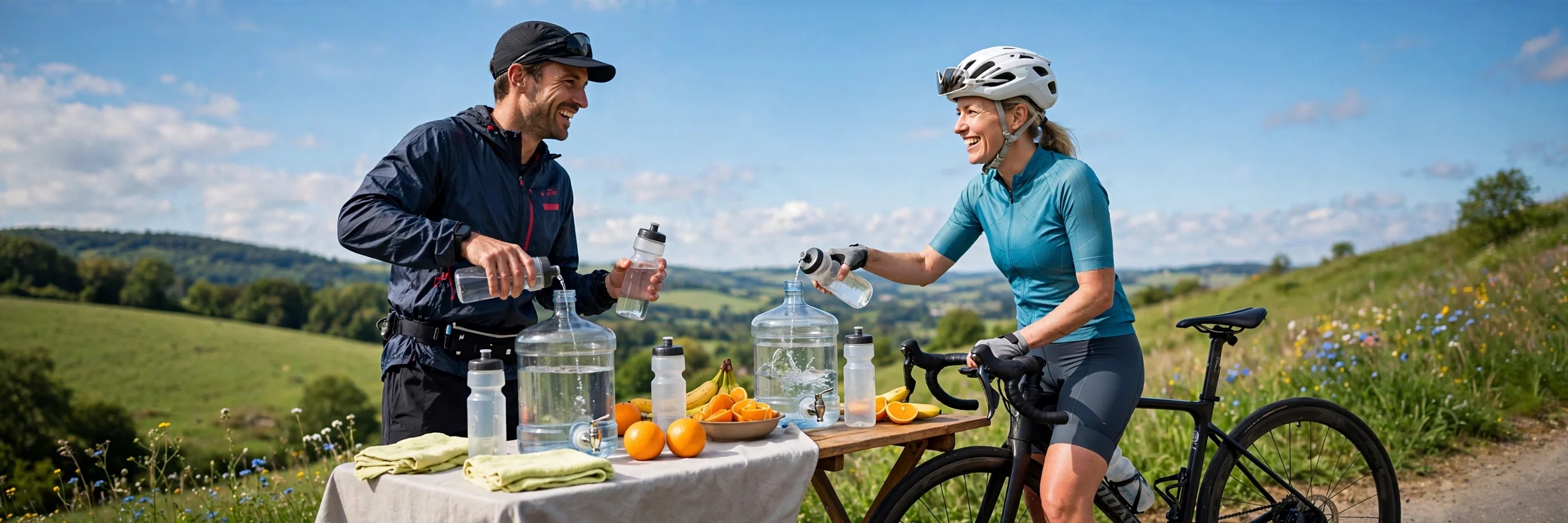
- Know the course's rhythm. Stations every X minutes at your pace: plan sips, not stops — a cup taken steadily beats a bottle chugged rarely.
- Carry your sodium; borrow their water. Course drinks vary wildly in concentration. Your own mix (a scoop of ION per bottle [L03]) is a constant; station water is the variable you can trust.
- Front-load nothing. Arrive euhydrated [A01]; a litre forced down in the start corral is a sloshing stomach and an early toilet stop, not a head start.
- After the finish, replace like you mean it: fluid and sodium across the next hours with food, until weight and urine colour normalise. The recovery window sets up tomorrow's training, not just today's comfort.
- Cycling note: the bike is the easiest place to drink and the easiest place to overdrink — bottles are always in reach and sweat evaporates invisibly in the wind, so riders misjudge in both directions. The scale after long rides is the correction.
Frequently asked questions
How much should I drink during a marathon or long ride?
Individual — which is the point. Build your per-hour range from sweat-rate tests in similar conditions, drink to thirst within it, and aim to finish no more than about 2% of body mass down [A01]. Anyone quoting you a universal litres-per-hour figure has not seen your data.
When do I actually need electrolytes instead of water?
As sessions stretch past one to two hours — sooner in heat, sooner for salty sweaters — cumulative sodium losses become the limiting factor [S01]. Under an hour, water plus your normal meals covers nearly everyone.
Can I drink too much water in an endurance event?
Yes — it is the primary mechanism of hyponatremia [E01]. The warning pattern is drinking beyond thirst on a fixed schedule, gaining weight during the event, and symptoms like bloating, nausea, confusion or puffiness. Drink to thirst; never finish heavier than you started.
How salty is my sweat, and why does it matter?
Sweat sodium ranges roughly 10–90 mmol/L between athletes [S01]. Salt crusts on kit and skin, stinging eyes and strong post-session salt cravings mark the high end. Salty sweaters need the top of the sodium range on long days; everyone else plans mid-range.
What is the best drink for long sessions in this line?
NutriRise ION — Quantum Ice is our long-session formula — 600 mg sodium and 444 mg potassium per serving [L03] — because duration is a sodium problem before it is anything else. For sessions under ninety minutes, Warrior Code Vital Hydrate at 100 mg sodium [L01] is the proportionate tool.
Next step
Run the weigh-in test on your next long session, in race-like heat if you can, then read the athlete hydration guide to set your per-hour range — and the hyponatremia article before your first event over three hours.
References
[A01] American College of Sports Medicine — Position Stand: Exercise and Fluid Replacement (2007): start euhydrated; prevent more than 2% body-weight loss during exercise; sweat rates and electrolyte content vary considerably, so programmes should be customised; sweat rate can be estimated from pre/post body weight; drinks containing sodium benefit athletes during prolonged exercise: https://pubmed.ncbi.nlm.nih.gov/17277604/
[E01] Hew-Butler T et al. — Exercise-Associated Hyponatremia: 2017 Update (Frontiers in Medicine), summarising the 2015 Third International EAH Consensus: primary mechanism is overconsumption of hypotonic fluids beyond thirst with non-osmotic AVP release; weight gain during exercise is the hallmark; prevention centres on drinking to thirst: https://pmc.ncbi.nlm.nih.gov/articles/PMC5334560/
[S01] Baker LB — Sweating Rate and Sweat Sodium Concentration in Athletes: A Review of Methodology and Intra/Interindividual Variability (Sports Medicine, 2017): sweat sodium concentration spans roughly 10–90 mmol/L across athletes and varies considerably within and between individuals: https://link.springer.com/content/pdf/10.1007/s40279-017-0691-5.pdf
[L01] Warrior Code Vital Hydrate — Supplement Facts label (verified from the product page, 2026-10-28): per 1 scoop: sodium 100 mg, potassium 200 mg, magnesium 20 mg, calcium 40 mg: https://nutririse.com/products/warrior-code-vital-hydrate-lychee
[L03] NutriRise ION — Quantum Ice — Supplement Facts label (verified from the product page, 2026-10-28): per approx. 1 scoop: sodium 600 mg, potassium 444 mg, magnesium 40 mg: https://nutririse.com/products/nutririse-ion-quantum-ice-ultra-bioavailable-electrolyte-fuel
• Recommended Products:
.







 Cart (


