Saffron and Mood: What the Research Actually Shows

Quick answer

Saffron is the world's most expensive spice and, unusually for a supplement, it has real randomized-trial evidence behind it for mood — with real limits attached. In people diagnosed with depression, a meta-analysis of five trials found saffron reduced symptoms significantly more than placebo [SF01]. In healthy adults who simply reported low mood, a standardized extract at 28 mg a day improved mood and stress scores over four weeks — while 22 mg did nothing [SF02]. Those are two different populations, two different claims, and this library keeps them separate. Nothing here treats, cures or prevents depression or anxiety: if low mood persists beyond a couple of weeks, affects your functioning, or ever includes thoughts of harming yourself, that is a conversation for a professional — please have it promptly (in the US, call or text 988). What saffron may reasonably be is a studied option for everyday mood support — and this guide shows you the evidence, the label, and the line, so you can judge it like an adult.

Key takeaways

  • Two evidence piles, never merged: trials in diagnosed depression [SF01] and trials in healthy people with low mood [SF02]. Only the second describes most readers of this page.
  • Dose is specific, not "more is better": in the healthy-adult trial, 28 mg/day of a standardized extract worked and 22 mg/day did not [SF02].
  • Standardization is the whole ballgame: studied extracts declare their active compounds. Our own saffron label declares 88.5 mg of extract per capsule with no standardization percentage [SF-L01] — so we make no equivalence claim, and this guide teaches you to spot the difference on any label.
  • Safety is part of the story from page one: saffron plus antidepressant medication is a clinician conversation, not a self-experiment; pregnancy is a no from us (the safety article later in this library covers it in full; your clinician covers it now).
  • The library's order: evidence first, mechanisms second, real-life use third, and the help line — knowing the line between low mood and depression — woven through all of it.

What saffron actually is

Saffron is the dried stigma of the crocus flower Crocus sativus — three tiny red threads per flower, harvested by hand, which is why it costs what it costs and why the market is full of dyed imitations. The compounds researchers care about are crocin (the pigment, which the body converts to crocetin), safranal (the aroma), and picrocrocin (the bitter note). When a trial says "saffron extract," it means a preparation made from those stigmas, usually standardized so each dose carries a known amount of the active family. When a cooking spice jar says saffron, it means the threads themselves. The supplement question is never "saffron: yes or no?" — it is "which preparation, at which dose, in which people?" This library asks it that way every time.

The two piles of evidence (and why we never merge them)

Pile one: people with diagnosed major depression. Hausenblas and colleagues pooled the randomized trials in 2013 [SF01]: five trials, high methodological quality scores, and a large statistical effect for saffron over placebo on depression symptom scales — with saffron performing similarly to the antidepressant comparison drugs in the head-to-head trials. Impressive — and bounded: the trials were small, short, and conducted largely by research groups in Iran, and the authors themselves wrote that larger trials elsewhere, with long-term follow-up, are needed before firm conclusions. We report this pile because it is the reason saffron is taken seriously. We do not aim it at our readers as a promise: a trial result in diagnosed patients is not a supplement claim for everyone else, and depression is a medical condition with medical treatments.

Pile two: healthy people with low mood. Kell and colleagues (2017) studied 128 adults who reported low mood but were not diagnosed with depression [SF02]. On 28 mg/day of a standardized extract (affron®), four weeks brought significantly lower negative mood and stress/anxiety symptom scores than placebo; the 22 mg dose did not separate from placebo. Self-reported measures and a self-selected sample are stated limitations. This is the pile that describes the everyday reader — and its honest summary is: promising, dose-specific, preliminary.

The deep read of both piles — effect sizes in plain language, what Jadad scores mean, what we still don't know — is Saffron for Mood: What the Trials Actually Found. How saffron might work at all is How Saffron Works.

Reading a saffron label — including ours

Here is the label literacy this library insists on, demonstrated on our own bottle. NutriRise Saffron declares, per one veggie capsule: *Saffron Extract (Crocus sativus L.)(flower) — 88.50 mg, 120 capsules [SF-L01]. What it does not* declare is a standardization — no percentage of crocin, safranal or total Lepticrosalides, and no extract ratio. Compare the trials: 28–30 mg/day of extracts standardized to known active content [SF01][SF02]. Eighty-eight milligrams of an unstandardized extract is not "three times the studied dose" — without declared actives, milligram counts across products simply aren't comparable, ours included. We sell this product and we are telling you its label's limit plainly, because a library that hides its own shelf's fine print has no business grading anyone else's. The full dose-and-label walkthrough — what to look for, what affron® is, how adulteration works — is the dose article in this library's practical shelf group.

Where saffron sits in a real routine

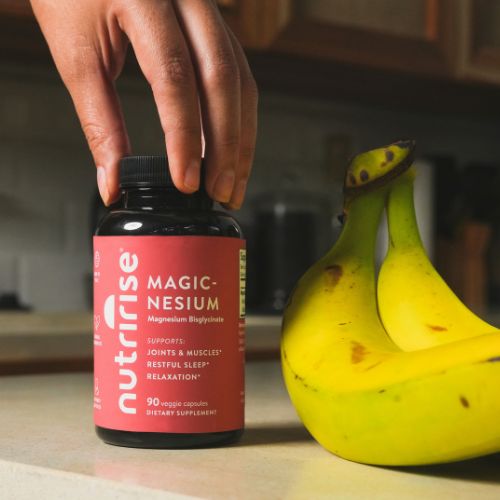
For a healthy adult with everyday low mood who has read the safety notes, saffron is a morning-or-midday capsule kind of supplement — one capsule a day on our label's serving [SF-L01] — sitting alongside the unglamorous foundations this company keeps repeating: sleep, daylight, movement, food, and the people you love. It is not a rescue remedy, not a same-day mood switch (the trials ran four weeks and longer [SF02]), and not a substitute for help when help is what's needed. Our shelf for this library pairs it with the other honest tools: Ashwagandha for the stress-and-tension side (a different botanical with its own evidence, compared directly in this library), Magnesium Biglycinate (275 mg elemental per serving [SF-L03]), Vitamin D3 (2,000 IU [SF-L05]), an evening option in Bedtime Bliss (melatonin 1 mg with calming herbs [SF-L04]), and AURA+ for daytime focus. The card row at the foot of this guide is that shelf; the articles are the instruction manual.

Frequently asked questions

Does saffron treat depression?

No — and no supplement should claim to. Saffron has been studied in depression trials with encouraging results [SF01], which is a statement about research, not a treatment offer. Depression is diagnosed and treated by professionals; if that's your situation, they are your first call, and this library's line-drawing article — Low Mood Isn't Depression — explains why we hold that line so firmly.

How long until saffron does anything?

The healthy-adult trial ran four weeks [SF02]; the depression trials typically six to eight. Anyone promising a same-day transformation is selling something other than evidence. Judge any mood-support supplement in weeks, with the rest of your routine held steady, or you'll never know what did what.

Can I take saffron with my antidepressant?

That's a clinician question, full stop. Saffron's proposed mechanisms touch serotonin pathways, so combining it with SSRIs, SNRIs, MAOIs or other serotonergic medication without medical supervision is exactly the kind of self-experiment this library exists to prevent. Ask your prescriber or pharmacist first.

Is saffron safe in pregnancy?

We don't recommend it. High-dose saffron has a traditional history as a uterine stimulant, and supplement-dose safety in pregnancy is not established — pregnancy is clinician-first territory for every product in this library.

Why is your own label's standardization missing — and should that stop me buying it?

Fair question, answered straight: the label declares extract weight (88.5 mg) without a standardization percentage [SF-L01], which limits how precisely its contents can be compared with studied extracts. Whether that trade-off is acceptable is genuinely your call — the dose article in this library walks through what standardization would tell you and what questions to ask of any brand, including ours.

Next step

Start with the evidence deep-read — Saffron for Mood: What the Trials Actually Found — then the mechanism, then decide. And if anything in this guide's help line sounded familiar, read the line-drawing article first — before any of it.

The saffron & mood library

The evidence

Mood in real life

References

[SF01] Hausenblas HA et al. — Saffron (Crocus sativus L.) and major depressive disorder: a meta-analysis of randomized clinical trials (Journal of Integrative Medicine, 2013; PMID 24299602): five RCTs in adults with MDD; large effect vs placebo (ES 1.62); similar efficacy to antidepressant comparators (ES −0.15); high Jadad quality; authors call for larger trials outside Iran with long-term follow-up: https://pubmed.ncbi.nlm.nih.gov/24299602/

[SF02] Kell G et al. — affron®, a novel saffron extract (Crocus sativus L.), improves mood in healthy adults over 4 weeks in a double-blind, parallel, randomized, placebo-controlled clinical trial (Complementary Therapies in Medicine, 2017; PMID 28735826): 128 healthy adults self-reporting low mood (not diagnosed); 28 mg/day significantly reduced negative mood and stress/anxiety symptoms vs placebo (POMS Total Mood Disturbance p<0.001, d=−1.10); 22 mg/day no significant effect; self-report limitations noted: https://pubmed.ncbi.nlm.nih.gov/28735826/

• Recommended Products:

.

NutriRise Saffron Supplement

NutriRise Saffron Supplement

$19.95

Order Now
NutriRise Ashwagandha Root 1300 MG

NutriRise Ashwagandha Root 1300 MG

$21.95

Order Now
NutriRise Ashwagandha Root 60C

NutriRise Ashwagandha Root 60C

$19.95

Order Now
NutriRise Magnesium Biglycinate

NutriRise Magnesium Biglycinate

$24.95

Order Now
NutriRise D3 Softgels

NutriRise D3 Softgels

$19.90

Order Now
NutriRise Bedtime Bliss Sleep Strips

NutriRise Bedtime Bliss Sleep Strips

$36.50

Order Now
Goddess Code AURA+

Goddess Code AURA+

$39.95

Order Now
Saffron and Mood: What the Research Actually Shows

Saffron and Mood: What the Research Actually Shows

Quick answer

Saffron is the world's most expensive spice and, unusually for a supplement, it has real randomized-trial evidence behind it for mood — with real limits attached. In people diagnosed with depression, a meta-analysis of five trials found saffron reduced symptoms significantly more than placebo [SF01]. In healthy adults who simply reported low mood, a standardized extract at 28 mg a day improved mood and stress scores over four weeks — while 22 mg did nothing [SF02]. Those are two different populations, two different claims, and this library keeps them separate. Nothing here treats, cures or prevents depression or anxiety: if low mood persists beyond a couple of weeks, affects your functioning, or ever includes thoughts of harming yourself, that is a conversation for a professional — please have it promptly (in the US, call or text 988). What saffron may reasonably be is a studied option for everyday mood support — and this guide shows you the evidence, the label, and the line, so you can judge it like an adult.

Key takeaways

  • Two evidence piles, never merged: trials in diagnosed depression [SF01] and trials in healthy people with low mood [SF02]. Only the second describes most readers of this page.
  • Dose is specific, not "more is better": in the healthy-adult trial, 28 mg/day of a standardized extract worked and 22 mg/day did not [SF02].
  • Standardization is the whole ballgame: studied extracts declare their active compounds. Our own saffron label declares 88.5 mg of extract per capsule with no standardization percentage [SF-L01] — so we make no equivalence claim, and this guide teaches you to spot the difference on any label.
  • Safety is part of the story from page one: saffron plus antidepressant medication is a clinician conversation, not a self-experiment; pregnancy is a no from us (the safety article later in this library covers it in full; your clinician covers it now).
  • The library's order: evidence first, mechanisms second, real-life use third, and the help line — knowing the line between low mood and depression — woven through all of it.

What saffron actually is

Saffron is the dried stigma of the crocus flower Crocus sativus — three tiny red threads per flower, harvested by hand, which is why it costs what it costs and why the market is full of dyed imitations. The compounds researchers care about are crocin (the pigment, which the body converts to crocetin), safranal (the aroma), and picrocrocin (the bitter note). When a trial says "saffron extract," it means a preparation made from those stigmas, usually standardized so each dose carries a known amount of the active family. When a cooking spice jar says saffron, it means the threads themselves. The supplement question is never "saffron: yes or no?" — it is "which preparation, at which dose, in which people?" This library asks it that way every time.

The two piles of evidence (and why we never merge them)

Pile one: people with diagnosed major depression. Hausenblas and colleagues pooled the randomized trials in 2013 [SF01]: five trials, high methodological quality scores, and a large statistical effect for saffron over placebo on depression symptom scales — with saffron performing similarly to the antidepressant comparison drugs in the head-to-head trials. Impressive — and bounded: the trials were small, short, and conducted largely by research groups in Iran, and the authors themselves wrote that larger trials elsewhere, with long-term follow-up, are needed before firm conclusions. We report this pile because it is the reason saffron is taken seriously. We do not aim it at our readers as a promise: a trial result in diagnosed patients is not a supplement claim for everyone else, and depression is a medical condition with medical treatments.

Pile two: healthy people with low mood. Kell and colleagues (2017) studied 128 adults who reported low mood but were not diagnosed with depression [SF02]. On 28 mg/day of a standardized extract (affron®), four weeks brought significantly lower negative mood and stress/anxiety symptom scores than placebo; the 22 mg dose did not separate from placebo. Self-reported measures and a self-selected sample are stated limitations. This is the pile that describes the everyday reader — and its honest summary is: promising, dose-specific, preliminary.

The deep read of both piles — effect sizes in plain language, what Jadad scores mean, what we still don't know — is Saffron for Mood: What the Trials Actually Found. How saffron might work at all is How Saffron Works.

Reading a saffron label — including ours

Here is the label literacy this library insists on, demonstrated on our own bottle. NutriRise Saffron declares, per one veggie capsule: *Saffron Extract (Crocus sativus L.)(flower) — 88.50 mg, 120 capsules [SF-L01]. What it does not* declare is a standardization — no percentage of crocin, safranal or total Lepticrosalides, and no extract ratio. Compare the trials: 28–30 mg/day of extracts standardized to known active content [SF01][SF02]. Eighty-eight milligrams of an unstandardized extract is not "three times the studied dose" — without declared actives, milligram counts across products simply aren't comparable, ours included. We sell this product and we are telling you its label's limit plainly, because a library that hides its own shelf's fine print has no business grading anyone else's. The full dose-and-label walkthrough — what to look for, what affron® is, how adulteration works — is the dose article in this library's practical shelf group.

Where saffron sits in a real routine

For a healthy adult with everyday low mood who has read the safety notes, saffron is a morning-or-midday capsule kind of supplement — one capsule a day on our label's serving [SF-L01] — sitting alongside the unglamorous foundations this company keeps repeating: sleep, daylight, movement, food, and the people you love. It is not a rescue remedy, not a same-day mood switch (the trials ran four weeks and longer [SF02]), and not a substitute for help when help is what's needed. Our shelf for this library pairs it with the other honest tools: Ashwagandha for the stress-and-tension side (a different botanical with its own evidence, compared directly in this library), Magnesium Biglycinate (275 mg elemental per serving [SF-L03]), Vitamin D3 (2,000 IU [SF-L05]), an evening option in Bedtime Bliss (melatonin 1 mg with calming herbs [SF-L04]), and AURA+ for daytime focus. The card row at the foot of this guide is that shelf; the articles are the instruction manual.

Frequently asked questions

Does saffron treat depression?

No — and no supplement should claim to. Saffron has been studied in depression trials with encouraging results [SF01], which is a statement about research, not a treatment offer. Depression is diagnosed and treated by professionals; if that's your situation, they are your first call, and this library's line-drawing article — Low Mood Isn't Depression — explains why we hold that line so firmly.

How long until saffron does anything?

The healthy-adult trial ran four weeks [SF02]; the depression trials typically six to eight. Anyone promising a same-day transformation is selling something other than evidence. Judge any mood-support supplement in weeks, with the rest of your routine held steady, or you'll never know what did what.

Can I take saffron with my antidepressant?

That's a clinician question, full stop. Saffron's proposed mechanisms touch serotonin pathways, so combining it with SSRIs, SNRIs, MAOIs or other serotonergic medication without medical supervision is exactly the kind of self-experiment this library exists to prevent. Ask your prescriber or pharmacist first.

Is saffron safe in pregnancy?

We don't recommend it. High-dose saffron has a traditional history as a uterine stimulant, and supplement-dose safety in pregnancy is not established — pregnancy is clinician-first territory for every product in this library.

Why is your own label's standardization missing — and should that stop me buying it?

Fair question, answered straight: the label declares extract weight (88.5 mg) without a standardization percentage [SF-L01], which limits how precisely its contents can be compared with studied extracts. Whether that trade-off is acceptable is genuinely your call — the dose article in this library walks through what standardization would tell you and what questions to ask of any brand, including ours.

Next step

Start with the evidence deep-read — Saffron for Mood: What the Trials Actually Found — then the mechanism, then decide. And if anything in this guide's help line sounded familiar, read the line-drawing article first — before any of it.

The saffron & mood library

The evidence

Mood in real life

References

[SF01] Hausenblas HA et al. — Saffron (Crocus sativus L.) and major depressive disorder: a meta-analysis of randomized clinical trials (Journal of Integrative Medicine, 2013; PMID 24299602): five RCTs in adults with MDD; large effect vs placebo (ES 1.62); similar efficacy to antidepressant comparators (ES −0.15); high Jadad quality; authors call for larger trials outside Iran with long-term follow-up: https://pubmed.ncbi.nlm.nih.gov/24299602/

[SF02] Kell G et al. — affron®, a novel saffron extract (Crocus sativus L.), improves mood in healthy adults over 4 weeks in a double-blind, parallel, randomized, placebo-controlled clinical trial (Complementary Therapies in Medicine, 2017; PMID 28735826): 128 healthy adults self-reporting low mood (not diagnosed); 28 mg/day significantly reduced negative mood and stress/anxiety symptoms vs placebo (POMS Total Mood Disturbance p<0.001, d=−1.10); 22 mg/day no significant effect; self-report limitations noted: https://pubmed.ncbi.nlm.nih.gov/28735826/

• Recommended Products:

.

NutriRise Saffron Supplement

NutriRise Saffron Supplement

$19.95

Order Now
NutriRise Ashwagandha Root 1300 MG

NutriRise Ashwagandha Root 1300 MG

$21.95

Order Now
NutriRise Ashwagandha Root 60C

NutriRise Ashwagandha Root 60C

$19.95

Order Now
NutriRise Magnesium Biglycinate

NutriRise Magnesium Biglycinate

$24.95

Order Now
NutriRise D3 Softgels

NutriRise D3 Softgels

$19.90

Order Now
NutriRise Bedtime Bliss Sleep Strips

NutriRise Bedtime Bliss Sleep Strips

$36.50

Order Now
Goddess Code AURA+

Goddess Code AURA+

$39.95

Order Now
Ramsha Mirza
Ramsha Mirza
Co-Founder of NutriRise
Co-founder of NutriRise and mother of three. Ramsha writes about th...
Learn More
Saffron and Mood: What the Research Actually Shows

Quick answer

Saffron is the world's most expensive spice and, unusually for a supplement, it has real randomized-trial evidence behind it for mood — with real limits attached. In people diagnosed with depression, a meta-analysis of five trials found saffron reduced symptoms significantly more than placebo [SF01]. In healthy adults who simply reported low mood, a standardized extract at 28 mg a day improved mood and stress scores over four weeks — while 22 mg did nothing [SF02]. Those are two different populations, two different claims, and this library keeps them separate. Nothing here treats, cures or prevents depression or anxiety: if low mood persists beyond a couple of weeks, affects your functioning, or ever includes thoughts of harming yourself, that is a conversation for a professional — please have it promptly (in the US, call or text 988). What saffron may reasonably be is a studied option for everyday mood support — and this guide shows you the evidence, the label, and the line, so you can judge it like an adult.

Key takeaways

  • Two evidence piles, never merged: trials in diagnosed depression [SF01] and trials in healthy people with low mood [SF02]. Only the second describes most readers of this page.
  • Dose is specific, not "more is better": in the healthy-adult trial, 28 mg/day of a standardized extract worked and 22 mg/day did not [SF02].
  • Standardization is the whole ballgame: studied extracts declare their active compounds. Our own saffron label declares 88.5 mg of extract per capsule with no standardization percentage [SF-L01] — so we make no equivalence claim, and this guide teaches you to spot the difference on any label.
  • Safety is part of the story from page one: saffron plus antidepressant medication is a clinician conversation, not a self-experiment; pregnancy is a no from us (the safety article later in this library covers it in full; your clinician covers it now).
  • The library's order: evidence first, mechanisms second, real-life use third, and the help line — knowing the line between low mood and depression — woven through all of it.

What saffron actually is

Saffron is the dried stigma of the crocus flower Crocus sativus — three tiny red threads per flower, harvested by hand, which is why it costs what it costs and why the market is full of dyed imitations. The compounds researchers care about are crocin (the pigment, which the body converts to crocetin), safranal (the aroma), and picrocrocin (the bitter note). When a trial says "saffron extract," it means a preparation made from those stigmas, usually standardized so each dose carries a known amount of the active family. When a cooking spice jar says saffron, it means the threads themselves. The supplement question is never "saffron: yes or no?" — it is "which preparation, at which dose, in which people?" This library asks it that way every time.

The two piles of evidence (and why we never merge them)

Pile one: people with diagnosed major depression. Hausenblas and colleagues pooled the randomized trials in 2013 [SF01]: five trials, high methodological quality scores, and a large statistical effect for saffron over placebo on depression symptom scales — with saffron performing similarly to the antidepressant comparison drugs in the head-to-head trials. Impressive — and bounded: the trials were small, short, and conducted largely by research groups in Iran, and the authors themselves wrote that larger trials elsewhere, with long-term follow-up, are needed before firm conclusions. We report this pile because it is the reason saffron is taken seriously. We do not aim it at our readers as a promise: a trial result in diagnosed patients is not a supplement claim for everyone else, and depression is a medical condition with medical treatments.

Pile two: healthy people with low mood. Kell and colleagues (2017) studied 128 adults who reported low mood but were not diagnosed with depression [SF02]. On 28 mg/day of a standardized extract (affron®), four weeks brought significantly lower negative mood and stress/anxiety symptom scores than placebo; the 22 mg dose did not separate from placebo. Self-reported measures and a self-selected sample are stated limitations. This is the pile that describes the everyday reader — and its honest summary is: promising, dose-specific, preliminary.

The deep read of both piles — effect sizes in plain language, what Jadad scores mean, what we still don't know — is Saffron for Mood: What the Trials Actually Found. How saffron might work at all is How Saffron Works.

Reading a saffron label — including ours

Here is the label literacy this library insists on, demonstrated on our own bottle. NutriRise Saffron declares, per one veggie capsule: *Saffron Extract (Crocus sativus L.)(flower) — 88.50 mg, 120 capsules [SF-L01]. What it does not* declare is a standardization — no percentage of crocin, safranal or total Lepticrosalides, and no extract ratio. Compare the trials: 28–30 mg/day of extracts standardized to known active content [SF01][SF02]. Eighty-eight milligrams of an unstandardized extract is not "three times the studied dose" — without declared actives, milligram counts across products simply aren't comparable, ours included. We sell this product and we are telling you its label's limit plainly, because a library that hides its own shelf's fine print has no business grading anyone else's. The full dose-and-label walkthrough — what to look for, what affron® is, how adulteration works — is the dose article in this library's practical shelf group.

Where saffron sits in a real routine

For a healthy adult with everyday low mood who has read the safety notes, saffron is a morning-or-midday capsule kind of supplement — one capsule a day on our label's serving [SF-L01] — sitting alongside the unglamorous foundations this company keeps repeating: sleep, daylight, movement, food, and the people you love. It is not a rescue remedy, not a same-day mood switch (the trials ran four weeks and longer [SF02]), and not a substitute for help when help is what's needed. Our shelf for this library pairs it with the other honest tools: Ashwagandha for the stress-and-tension side (a different botanical with its own evidence, compared directly in this library), Magnesium Biglycinate (275 mg elemental per serving [SF-L03]), Vitamin D3 (2,000 IU [SF-L05]), an evening option in Bedtime Bliss (melatonin 1 mg with calming herbs [SF-L04]), and AURA+ for daytime focus. The card row at the foot of this guide is that shelf; the articles are the instruction manual.

Frequently asked questions

Does saffron treat depression?

No — and no supplement should claim to. Saffron has been studied in depression trials with encouraging results [SF01], which is a statement about research, not a treatment offer. Depression is diagnosed and treated by professionals; if that's your situation, they are your first call, and this library's line-drawing article — Low Mood Isn't Depression — explains why we hold that line so firmly.

How long until saffron does anything?

The healthy-adult trial ran four weeks [SF02]; the depression trials typically six to eight. Anyone promising a same-day transformation is selling something other than evidence. Judge any mood-support supplement in weeks, with the rest of your routine held steady, or you'll never know what did what.

Can I take saffron with my antidepressant?

That's a clinician question, full stop. Saffron's proposed mechanisms touch serotonin pathways, so combining it with SSRIs, SNRIs, MAOIs or other serotonergic medication without medical supervision is exactly the kind of self-experiment this library exists to prevent. Ask your prescriber or pharmacist first.

Is saffron safe in pregnancy?

We don't recommend it. High-dose saffron has a traditional history as a uterine stimulant, and supplement-dose safety in pregnancy is not established — pregnancy is clinician-first territory for every product in this library.

Why is your own label's standardization missing — and should that stop me buying it?

Fair question, answered straight: the label declares extract weight (88.5 mg) without a standardization percentage [SF-L01], which limits how precisely its contents can be compared with studied extracts. Whether that trade-off is acceptable is genuinely your call — the dose article in this library walks through what standardization would tell you and what questions to ask of any brand, including ours.

Next step

Start with the evidence deep-read — Saffron for Mood: What the Trials Actually Found — then the mechanism, then decide. And if anything in this guide's help line sounded familiar, read the line-drawing article first — before any of it.

The saffron & mood library

The evidence

Mood in real life

References

[SF01] Hausenblas HA et al. — Saffron (Crocus sativus L.) and major depressive disorder: a meta-analysis of randomized clinical trials (Journal of Integrative Medicine, 2013; PMID 24299602): five RCTs in adults with MDD; large effect vs placebo (ES 1.62); similar efficacy to antidepressant comparators (ES −0.15); high Jadad quality; authors call for larger trials outside Iran with long-term follow-up: https://pubmed.ncbi.nlm.nih.gov/24299602/

[SF02] Kell G et al. — affron®, a novel saffron extract (Crocus sativus L.), improves mood in healthy adults over 4 weeks in a double-blind, parallel, randomized, placebo-controlled clinical trial (Complementary Therapies in Medicine, 2017; PMID 28735826): 128 healthy adults self-reporting low mood (not diagnosed); 28 mg/day significantly reduced negative mood and stress/anxiety symptoms vs placebo (POMS Total Mood Disturbance p<0.001, d=−1.10); 22 mg/day no significant effect; self-report limitations noted: https://pubmed.ncbi.nlm.nih.gov/28735826/

• Recommended Products:

.

NutriRise Saffron Supplement

NutriRise Saffron Supplement

$19.95

Order Now
NutriRise Ashwagandha Root 1300 MG

NutriRise Ashwagandha Root 1300 MG

$21.95

Order Now
NutriRise Ashwagandha Root 60C

NutriRise Ashwagandha Root 60C

$19.95

Order Now
NutriRise Magnesium Biglycinate

NutriRise Magnesium Biglycinate

$24.95

Order Now
NutriRise D3 Softgels

NutriRise D3 Softgels

$19.90

Order Now
NutriRise Bedtime Bliss Sleep Strips

NutriRise Bedtime Bliss Sleep Strips

$36.50

Order Now
Goddess Code AURA+

Goddess Code AURA+

$39.95

Order Now
Cart (0)
Your Cart Is Empty!
Start With Our Best Sellers
NutriRise Ashwagandha Root 1300 MG | Organic Black Pepper Extract | 120 Capsules
$21.95
NutriRise 15-Day Rapid Cleanse | 9 Natural Ingredients with Aloe Vera & Senna | Plus Probiotics
$15.45
NutriRise Glucosamine Chondroitin MSM | 8 Ingredient Joint Support Blend | 90 Capsules
$29.95
Thanks for contacting us! We'll get back to you shortly. Thanks for subscribing Thanks! We will notify you when it becomes available! Product is out of stock. There is only one item left to add to the cart There are only [num_items] items left to add to the cart