


Quick answer
Mood and sleep are one system with two doors: a bad fortnight of sleep drags mood down, and a low, looping mind keeps sleep shallow. Saffron has been trialled on the sleep side directly — not as a sedative, but for sleep quality in adults who sleep poorly. In a 28-day randomized trial of 63 healthy adults with self-reported poor sleep, a standardized extract (affron®, 14 mg twice daily) improved insomnia-severity scores, restorative-sleep scores and sleep-diary quality ratings more than placebo [SF03]. A second, larger trial (120 adults, 28 days) tested evening doses taken an hour before bed and found improved sleep-quality ratings and morning mood, alongside increased evening melatonin concentrations [SF04]. The honest limits ride along: everyone in these trials had self-reported poor sleep, not diagnosed insomnia; outcomes were self-reported, not measured by sleep lab; and the extracts were standardized commercial preparations — not our unstandardized capsule [SF-L01], a distinction this library never blurs. Diagnosed insomnia, sleep apnea, or low mood past the two-week line are clinician territory — Knowing the Line maps that boundary. And if poor sleep ever travels with thoughts of harming yourself, call or text 988 (US) first and read later.
Key takeaways
- Two proper sleep trials exist [SF03][SF04] — saffron is one of the few botanicals trialled for sleep quality in poor sleepers rather than borrowing sleep claims from mood studies.
- The effect is on quality ratings (falling asleep, feeling restored, diary scores), not knockout sedation: nobody in these trials was drugged to sleep.
- Timing in the trials: twice daily [SF03], or a single evening dose about an hour before bed [SF04] — the evening pattern is the practical template.
- The melatonin finding [SF04] is measured and interesting — evening melatonin concentrations rose on saffron while cortisol didn't change — but it's a biomarker in one trial, not a licence to call saffron "natural melatonin."
- Evening tools stack by job, not by hope: saffron (quality, cumulative) is a different job from melatonin (timing signal, same-night) — our Bedtime Bliss strips (melatonin 1 mg + calming herbs [SF-L04]) are the same-night layer, and combining sleep aids of any kind deserves a pharmacist's thirty seconds if you take medication.
The two trials, read closely
Lopresti 2020 [SF03] was the first trial built specifically to test saffron for sleep. Sixty-three healthy adults, 18–70, all with self-reported sleep problems, took affron® 14 mg twice daily or placebo for 28 days; 55 completed and were analysed. On the Insomnia Severity Index — a standard questionnaire where lower is better — the saffron group improved significantly more than placebo (P=.017), as they did on the Restorative Sleep Questionnaire (P=.029) and on daily sleep-diary quality ratings (P=.014). No adverse effects were reported. The authors' own conclusion asks for exactly what you'd want next: larger samples, longer periods, objective (measured, not self-reported) outcomes. Take both halves.
Lopresti 2021 [SF04] scaled up and asked about timing: 120 adults with unsatisfactory sleep took 14 mg or 28 mg of affron®, or placebo, one hour before bed for 28 days. Both doses improved sleep-quality ratings versus placebo, and the saffron groups woke with better morning mood. The biomarker subplot is the part researchers quote: evening melatonin concentrations increased in the saffron groups, while evening cortisol stayed flat. One plausible read is that saffron supports the body's own evening wind-down chemistry rather than sedating from outside — plausible, singular, and not yet a mechanism anyone should print on a bottle, including us. Both trials, for the record, used a specific standardized extract made by a company with a commercial interest in it — the standing caveat of this whole evidence base [SF02].
The evening, built properly
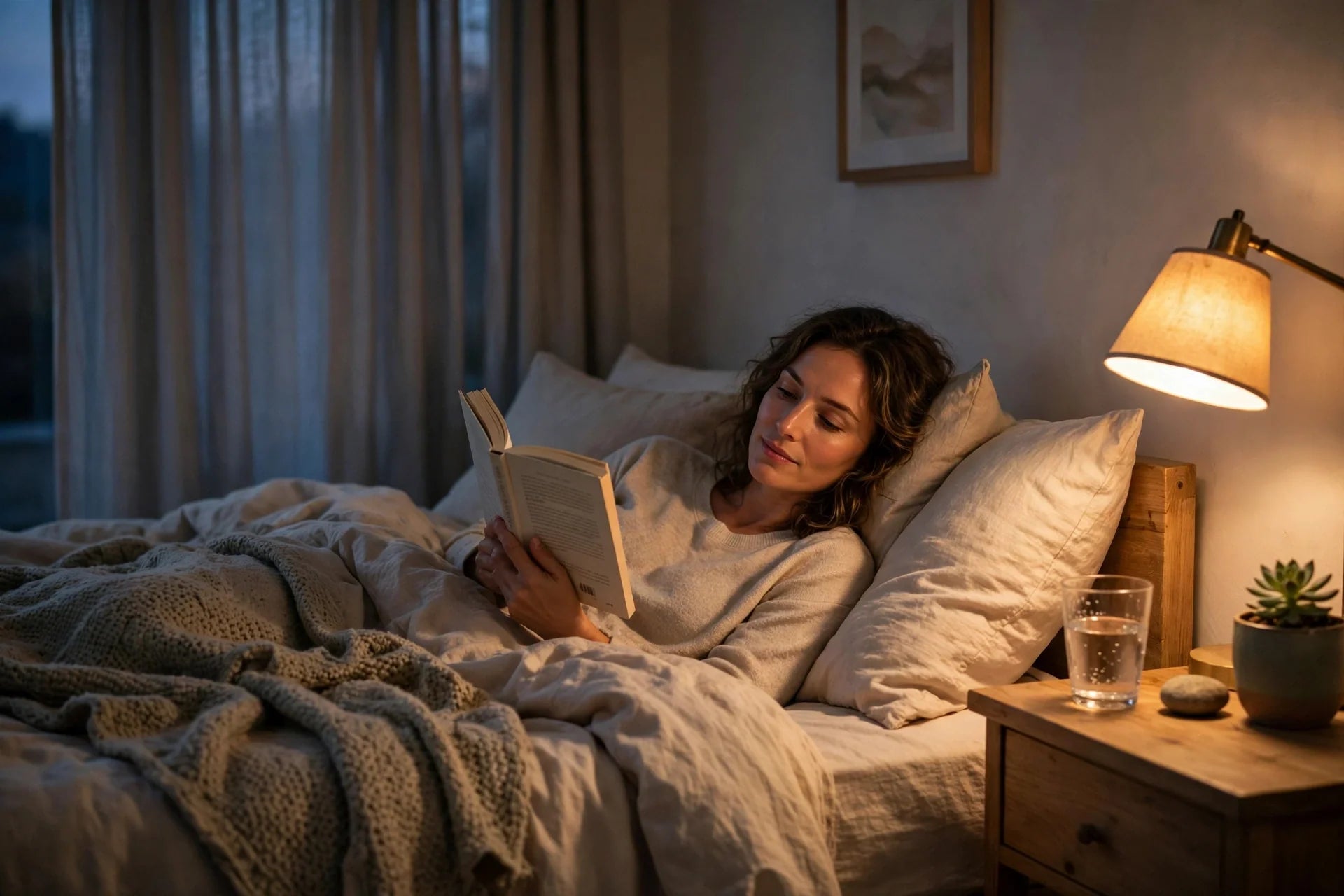
Whatever you add, the architecture matters more than the ingredients — the same lesson our hydration library teaches about the night before a good morning in the morning-hydration guide. Light low after dinner, the phone out of the bed's gravity, caffeine already cut since midday (if that sentence stings, the caffeine audit awaits), a room cool enough to need the blanket. Then the layers, by job:
The cumulative layer — saffron. If you trial it, mirror the research pattern: a daily routine judged over four weeks, with the evening-dose timing of the 2021 trial as the template [SF04]. Our capsule is one per day on the label [SF-L01]; what it shares with the trial extract is the plant, not the standardization — judge it on your own four weeks of sleep diary, not on Lopresti's P-values.
The same-night layer — a wind-down strip. Bedtime Bliss is built for the night itself: melatonin 1 mg — a modest, timing-signal dose rather than the 5–10 mg sledgehammers on the market — with valerian root extract 50 mg, lavender 20 mg, chamomile 10 mg and hibiscus 10 mg, in a strip that dissolves on the tongue [SF-L04]. Melatonin is a hormone; if you're pregnant, nursing, or on medication, it joins the clinician conversation too.
The environment layer. A dark room and a consistent wake time will out-perform any stack. This is said with love by people who sell the stack.
What the sleep trials don't tell us yet
Three gaps deserve plain statement. First, nobody wore a sensor: both trials measured sleep by questionnaire and diary — how sleep felt — not by actigraphy or sleep-lab staging, so we know perceived quality improved and not (yet) whether deep-sleep minutes moved. Second, the populations were narrow: volunteers with self-reported poor sleep who were otherwise healthy — not people with diagnosed insomnia, apnea, restless legs, or depression, whose sleep problems have different machinery and different right answers. Third, four weeks is a beginning, not a verdict: whether quality gains persist at three or six months, and whether they survive stopping, is unstudied for saffron. None of this cancels the findings — two positive randomized trials is more than most botanicals ever get — but it prices them correctly: a promising, well-tolerated, short-horizon result in people whose sleep was unsatisfying rather than disordered.
Frequently asked questions
Is saffron a sleeping pill?
No. Nothing in the trials sedated anyone; the improvements were in sleep-quality and restoration ratings over weeks [SF03][SF04]. If you need help falling asleep tonight, that's the same-night layer and the environment — and if sleeplessness is chronic or severe, it's a clinician, because conditions like sleep apnea don't care about your supplement shelf.
Why did melatonin go up in the 2021 trial?
Unknown, precisely. The finding — higher evening melatonin concentrations on saffron, cortisol unchanged [SF04] — suggests saffron may support the body's own evening signalling. It's a single trial's biomarker result: interesting, hypothesis-grade, and exactly why we don't print "boosts melatonin" anywhere near a product.
Morning or evening — when do I take it?
The sleep trials used twice-daily [SF03] or pre-bed evening dosing [SF04]; the mood trial dosed without an evening emphasis [SF02]. If sleep is your target, the evening pattern is the one with evidence behind it. Our label's serving is one capsule daily [SF-L01] — timing within your day is your routine's choice; consistency is the variable the trials actually reward.
Can I take saffron and a melatonin product together?
They do different jobs and people do layer them, but "people do" isn't a safety review: if you take any prescription medication — especially anything serotonergic or sedating — ask your pharmacist or prescriber first. Pregnancy and nursing: clinician first for both, every time.
My problem is waking at 3 a.m. with my mind racing — is that this article?
Half of it is: the sleep-quality side lives here; the racing-mind side lives in Saffron, Stress and the Overthinking Mind, written for exactly that loop. If the 3 a.m. pattern comes with the two-week mood markers, Knowing the Line outranks both.
Next step
Back to the pillar guide for the full map — and one small experiment worth more than any article: keep a two-line sleep diary (bedtime, how the night felt, 1–5) for the next four weeks. Every claim in this library eventually answers to that notebook.
References
[SF03] Lopresti AL et al. — Effects of saffron on sleep quality in healthy adults with self-reported poor sleep: a randomized, double-blind, placebo-controlled trial (Journal of Clinical Sleep Medicine, 2020; PMID 32056539): 63 adults (55 analysed), affron® 14 mg twice daily × 28 days; ISI improved vs placebo (P=.017), Restorative Sleep Questionnaire (P=.029), sleep-diary quality (P=.014); all outcomes self-reported; no adverse effects; authors call for larger, longer, objective-measure replication: https://pubmed.ncbi.nlm.nih.gov/32056539/
[SF04] Lopresti AL et al. — An investigation into an evening intake of a saffron extract (affron®) on sleep quality, cortisol, and melatonin concentrations in adults with poor sleep: a randomised, double-blind, placebo-controlled, multi-dose study (Sleep Medicine, 2021; PMID 34438361): 120 adults; affron® 14 mg or 28 mg one hour before bed × 28 days; sleep-quality ratings and morning mood improved; evening melatonin concentrations increased, cortisol unchanged: https://pubmed.ncbi.nlm.nih.gov/34438361/
[SF02] Kell G et al. — affron® improves mood in healthy adults over 4 weeks (Complementary Therapies in Medicine, 2017; PMID 28735826) — the mood-side trial and the source of the standardized-extract context: https://pubmed.ncbi.nlm.nih.gov/28735826/
• Recommended Products:
.






 Cart (


